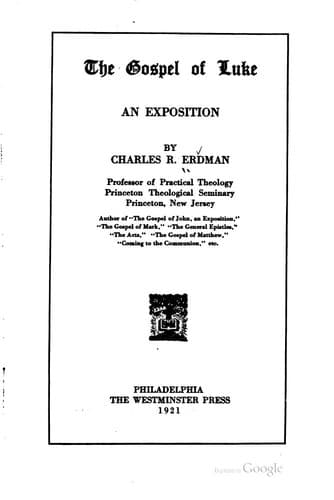
The Gospel of Luke, an expositionErdman, Charles Rosenbury
Religion
The Gospel of Luke, an exposition
Erdman, Charles Rosenbury
Bible. Luke -- Commentaries
These Pharisees ridiculed our Lord for teaching the absolute necessity of
generosity and benevolence and the unselfish use of wealth. Our Lord
replied that while these enemies of his might receive the approval of men,
God read their hearts and many who received human praise were but
abominable in the sight of God. Jesus stated that while the gospel message
did differ from the Law and while many were eagerly accepting its blessed
privileges, it did not set aside the Law, but only showed how its demands
could be met. When he stated that “one tittle of the law” could not fall,
he referred to the minute projections which distinguish Hebrew letters,
and meant that the slightest requirement of the Law was sacred and
abiding. He illustrated these truths by a reference to the Seventh
Commandment, and insisted that adultery did not lose its sinful character
because of any interpretation of the Law such as was put upon it by those
who were teaching lax theories of divorce. It was still sinful, even when
justified by civil enactment. Thus Jesus was reminding the Pharisees that
the Law might abide and be sacred even when legalists who observed its
letter were condemned.
In the parable of the Rich Man and Lazarus, Jesus by no means taught that
it is sinful to be rich or that the poor are all saved. He did mean to
suggest the solemn peril of the selfish use of wealth. The sin of the rich
man did not consist either in the way in which he had acquired his wealth
or in the fact that he possessed it, nor yet in any breach of moral law,
but in the plain statement that while he was living in selfish luxury one
who was in sore need lay unrelieved at his door. The rich man is commonly
called Dives, the Latin name for “a man of wealth.” Lazarus is the only
person in any parable of our Lord to whom a special name is given. It is
just possible that the name was intended to indicate the character of the
man as one who trusted in the help of God. The story shows not only the
contrast between the two men in the present life, but the still greater
contrast in the life that is to come. The picture is not to be interpreted
with absurd literalness; but it does contain a serious warning, and behind
its figures of speech are solemn realities. It does indicate the remorse
and the anguish which forever may be experienced by those who upon earth
make only a selfish and heartless use of wealth and position and
opportunity. The consequences are shown to be as endless as they are
distressing. A time of reversal is to come, a time of judgment and
retribution.
It is evident that Jesus was especially warning the Pharisees; the rich
man was a representative of this class who were notorious for their
scrupulous observance of law and for their lives of selfish luxury and
indulgence. The rich man addressed Abraham as his father, and was
addressed by Abraham as his son. This is an intimation that the most
orthodox Jew might be lost and come at last to a place of torment.
Public-domain text, read in full here on John Shaqi.
Reviews
Reviews
No reviews yet
Be the first to share your thoughts on this work.
Elsewhere in the archive
Join the Discussion
Join the discussion
Sign in to leave a comment or review.
Sign InorCreate an account