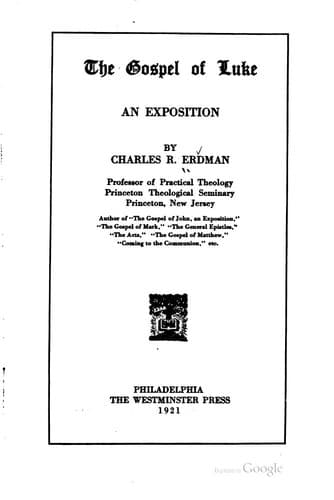
The Gospel of Luke, an expositionErdman, Charles Rosenbury
Religion
The Gospel of Luke, an exposition
Erdman, Charles Rosenbury
Bible. Luke -- Commentaries
47 And he was teaching daily in the temple. But the chief priests
and the scribes and the principal men of the people sought to
destroy him: 48 and they could not find what they might do; for
the people all hung upon him, listening.
The story of Luke is never lacking in human interest, but no scene is more
suffused with sentiment, none more vivid with color, than that which
pictures Jesus entering Jerusalem in triumph. We see our Lord mounted as a
king, surrounded by acclaiming multitudes, sweeping over the brow of
Olivet, while his attendant disciples spread their garments in the way and
hail him as the Messiah. We see him lamenting over the doomed city and
hear the harsh tones of the rulers who are plotting his death. With all
these shouts of joy and sobs of grief and mutterings of malice, surely no
scene is so full of emotion and none can illustrate more strikingly the
relation between religious feeling and religious faith.
An appeal to the eye and ear and heart may awaken sentiment and prepare
the way for the surrender of the will. There is to-day a proper place for
music and architecture and eloquence as aids to devotion. In the case of
the triumphal entry, Jesus planned every detail. He sent two disciples to
secure the colt on which he was to ride; he allowed the disciples to place
on the colt their garments, and as he rode toward the city he accepted the
acclamations of the crowd. When the Pharisees criticized Jesus for
permitting such praise and arousing such excitement, he declared that such
homage to himself was not only proper but necessary, and that if the
multitudes were silenced the very stones would “cry out” to welcome and to
honor him. Jesus was offering himself as King for the last time, and
therefore his offer was to be made in the most impressive way. He appealed
to the imagination. He stirred the emotions. He did not mean that he was
to be such a king as the people supposed; the borrowed colt, the garments
of peasants, the banners of leafy branches were not to be the permanent
furnishings of a court. He wished to secure the submission of their wills,
the complete surrender of their lives, and therefore he made this
stirring, dramatic, emotional appeal to the multitudes. He knew that
religious feeling is an aid to religious faith.
Public-domain text, read in full here on John Shaqi.
Reviews
Reviews
No reviews yet
Be the first to share your thoughts on this work.
Elsewhere in the archive
Join the Discussion
Join the discussion
Sign in to leave a comment or review.
Sign InorCreate an account