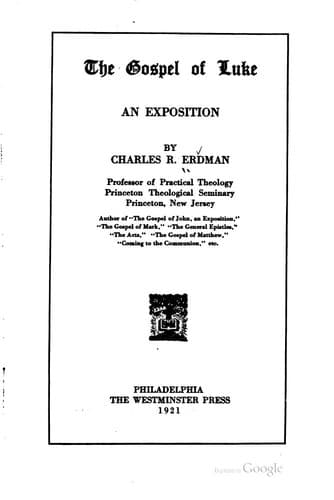
The Gospel of Luke, an expositionErdman, Charles Rosenbury
Religion
The Gospel of Luke, an exposition
Erdman, Charles Rosenbury
Bible. Luke -- Commentaries
After his triumphal entry into the city, Jesus continued to be the popular
idol of the multitudes that thronged Jerusalem at the passover season. It
was this popularity which delayed the designs of the rulers, as they had
determined to put Jesus to death. They must first discredit him with the
people. With this in view they sent a deputation from their chief court,
the sanhedrin, to entrap Jesus in his talk or to bring him into conflict
with the Jewish or Roman rulers. They challenged him to state by what
authority he was receiving such honors as the Messiah, or driving the
traders from the Temple, or performing his miracles. Their question was
framed with subtle skill, “By what authority doest thou these things? or
who is he that gave thee this authority?” They placed Jesus in a dilemma;
if he should claim that authority had been delegated to him, then he might
be accused of disloyalty and of schism, in supplanting the recognized
“authorities” of the Jewish state; if he should claim inherent divine
authority, as identified with God, he might be condemned for blasphemy.
Jesus silenced his enemies with a question which involved them in a
counter dilemma: “The baptism of John, was it from heaven, or from men?”
They could not say “from heaven,” for they had rejected John; they dared
not say “from men,” for they feared the people by whom John was regarded
as a prophet. So they tried to escape by cowardly replying that they did
not know. Agnosticism is usually cowardly and deserving of little respect.
But Jesus did more than silence them; he answered them. His question was
no irrelevant riddle by which he met a difficulty and delayed the
necessity of a reply. He definitely implied that the authority of John was
divine and that his own authority was the same; but as they were afraid to
deny the divine authority of John they were also powerless to deny that of
Jesus; and further he implied that if they had accepted the message of
John, they would be prepared to accept Jesus. It is true that if we are
afraid to accept the logical conclusions of our doubts and denials, we
never can hope to discover truth.
Jesus further rebuked and exposed his enemies. When they said that they
did not know, Jesus knew, and they knew, and the crowds knew, that they
were not honest; the Lord had laid bare their hypocrisy; he had made it
perfectly evident that the real question at issue was not authority but
obedience. The enemies of Jesus pretended that they wanted to know more of
his credentials; they really wanted to discredit and entrap him. The
modern enemies of our Lord declare that they want more proofs, more
evidence; what they really lack is love for God and submission to his
will. Those who do not repent when John preaches, will not believe when
Jesus offers to save. The world needs to-day, not more proof of divine
authority, but more obedience to the divine will.
Public-domain text, read in full here on John Shaqi.
Reviews
Reviews
No reviews yet
Be the first to share your thoughts on this work.
Elsewhere in the archive
Join the Discussion
Join the discussion
Sign in to leave a comment or review.
Sign InorCreate an account