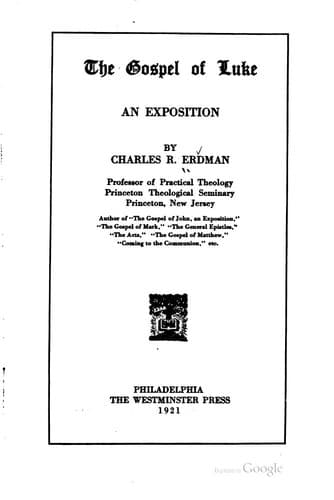
The Gospel of Luke, an expositionErdman, Charles Rosenbury
Religion
The Gospel of Luke, an exposition
Erdman, Charles Rosenbury
Bible. Luke -- Commentaries
In speaking of his return in glory, Jesus mentioned certain definite signs
by which his followers will know that his coming is near. To explain more
clearly the purpose of these “signs,” Jesus spoke a brief parable in which
he compared their appearance to the foliage put forth in the springtime
which becomes a certain harbinger of the summer. Many have supposed that
Jesus indicated Israel by his reference to “the fig tree” and have
concluded that a revival of Judaism and a return of the Jews to Palestine
will be a certain indication that the present age is drawing to its close.
Whatever may be predicted elsewhere concerning the Jews, there is no such
reference here, for Jesus not only said, “Behold the fig tree,” but also,
“all the trees.” His meaning is perfectly plain. He did not refer to
nations under the figure of trees, but he declared that as the foliage is
a sure precursor of summer, so the signs of which he spoke are a certain
indication of his imminent return. “Even so ye also, when ye see these
things coming to pass, know ye that the kingdom of God is nigh,” the
Kingdom which is to be established in glory at the appearing of our Lord.
Jesus further awakened the expectation of his hearers by the statement,
“This generation shall not pass away, till all things be accomplished.” It
is improbable, as again many have supposed, that Jesus referred to the
Hebrew race by the term “this generation.” The words are almost certainly
to be interpreted in their usual significance and “all things” to be
“accomplished” refers to the destruction of Jerusalem regarded as the type
and symbol of the return of Christ. These two events are thus closely
related in this prophetic discourse and the literal fulfillment of the
first gives to believers a more confident assurance of the certain
occurrence of the latter: “Heaven and earth shall pass away: but my words
shall not pass away.” The hope that our Lord will come is not based on
human conjectures, but on his own unfailing predictions. All that is
material and temporal may cease to exist, but his promises are eternal.
In view of such glorious prophecies the heart of the Christian is ever to
be set upon the gracious realities relating to the coming of the Master.
The followers of Christ must be on their guard lest they be overcome by
the influences which Jesus described as characterizing the days
immediately preceding his return. There will be temptation to
self-indulgence and indifference and absorption in worldly cares.
Believers are warned to be on their watch lest the coming of Christ
overtake them unexpectedly, as indeed it will come upon others. They are
urged to watch and to pray that they may be able to escape from those
judgments which will break upon a guilty world, and may be counted worthy
to take their places in the glorious Kingdom of their Lord.
5. The Historic Statement. Ch. 21:37, 38
Public-domain text, read in full here on John Shaqi.
Reviews
Reviews
No reviews yet
Be the first to share your thoughts on this work.
Elsewhere in the archive
Join the Discussion
Join the discussion
Sign in to leave a comment or review.
Sign InorCreate an account