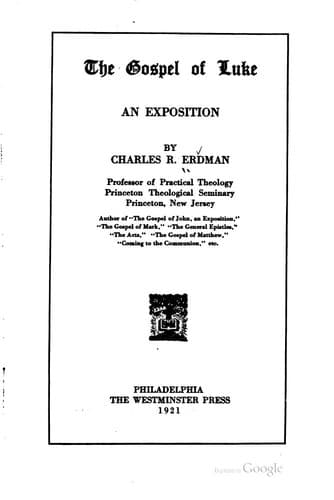
The Gospel of Luke, an expositionErdman, Charles Rosenbury
Religion
The Gospel of Luke, an exposition
Erdman, Charles Rosenbury
Bible. Luke -- Commentaries
The death of Christ was an event of such supreme importance that it
properly was accompanied by supernatural signs of deep significance. Of
these Luke mentions two. The first was the darkened skies, a fit symbol of
the blackest crime in all the history of man. The second was the rending
of the Temple veil, a type of the “new and living way” opened into the
presence of God for all believers. Thus these two signs correspond to the
human and the divine aspects of this atoning death, and indicate the
heinousness of sin and the purpose of redeeming grace.
The last word spoken by Jesus on the cross was an expression of perfect
trust and peace. He had shown his sympathy for others by his prayer, by
his promise to the penitent thief, and by his provision for his mother; by
three other words he had revealed his sufferings of mind and body and
their result in a completed redemption: “My God, my God ...”; “I thirst;”
“it is finished.” He now breathed out his soul in a sentence of absolute
confidence taken from the psalmist and recorded by Luke alone: “Father,
into thy hands I commend my spirit.” It was the supreme utterance of
faith. The earthly ministry of the Son of God had ended.
Luke notes the effects produced by the manner of Jesus’ death, and by the
accompanying signs upon the Roman centurion, the Jewish multitudes, and
the Christian disciples. The soldier was so impressed that he “glorified
God,” giving his testimony to the fact that the One whom he had crucified
as a criminal was a “righteous man.” Possibly he may be regarded as a type
of that host of believing Gentiles, of whom Luke liked to write, who were
yet to enlist under the banner of the cross.
The crowds of Jews had little real desire for the crucifixion of Jesus;
they had been hounded by their rulers to cry out for his death, but they
now returned to the city “smiting their breasts” in an agony of remorse, a
prophecy of Israel’s future repentance and mourning as they “look on him
whom they pierced.”
Most pathetic of all was that group of saddened disciples who “stood afar
off” gazing in bewilderment upon the scene; but for them the meaning of
that cross would begin to dawn as they should meet their risen Lord. For
none of his followers has the cross lost its mystery; yet to them all it
has become a symbol of triumph and of hope.
Public-domain text, read in full here on John Shaqi.
Reviews
Reviews
No reviews yet
Be the first to share your thoughts on this work.
Elsewhere in the archive
Join the Discussion
Join the discussion
Sign in to leave a comment or review.
Sign InorCreate an account