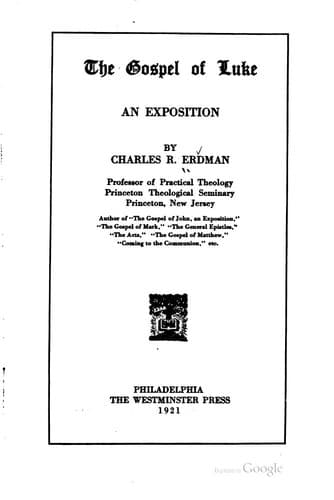
The Gospel of Luke, an expositionErdman, Charles Rosenbury
Religion
The Gospel of Luke, an exposition
Erdman, Charles Rosenbury
Bible. Luke -- Commentaries
11 And it came to pass soon afterwards, that he went to a city
called Nain; and his disciples went with him, and a great
multitude. 12 Now when he drew near to the gate of the city,
behold, there was carried out one that was dead, the only son of
his mother, and she was a widow: and much people of the city were
with her. 13 And when the Lord saw her, he had compassion on her,
and said unto her, Weep not. 14 And he came nigh and touched the
bier: and the bearers stood still. And he said, Young man, I say
unto thee, Arise. 15 And he that was dead sat up, and began to
speak. And he gave him to his mother. 16 And fear took hold on
all: and they glorified God, saying, A great prophet is arisen
among us: and, God hath visited his people. 17 And this report
went forth concerning him in the whole of Judæa, and all the
region round about.
If it was the purpose of Luke to impress upon his readers the sympathy and
tenderness of the Man Christ Jesus, it is easy to understand why he alone
of all the evangelists records this touching story of the raising from the
dead of the son of the widow of Nain. No picture could be more full of
pity and compassion. Jesus had not been asked to perform the miracle; he
was moved wholly by the mute appeal of human sorrow and distress. As he
drew near to the gate of the little city, he met the sad procession
wending its way out to the place of burial. He was touched by the tears of
the lonely mother who had lost her only son; moved with deep compassion he
spoke to her the word of hope, “Weep not.” Then he came near and touched
the bier on which the lifeless body was being borne. It was a sign more
eloquent than a spoken word. Then came the command: “Young man, I say unto
thee, Arise. And he that was dead sat up, and began to speak. And he gave
him to his mother.” In view of such miracles, possibly we dwell too
exclusively upon their purpose as authenticating the mission of Jesus, or
as demonstrating his divine message. These purposes are real, but we must
never forget that such works were also manifestations of the nature of the
ministry of Jesus and revelations of the very heart of God. Such recitals
dry the tears of mourners and bind up broken hearts and inspire the
despondent with eternal hope. Surely Jesus is the Lord of life and he will
yet wipe away all tears from the eyes of those that trust him.
5. Jesus Praising John. Ch. 7:18-35
Public-domain text, read in full here on John Shaqi.
Reviews
Reviews
No reviews yet
Be the first to share your thoughts on this work.
Elsewhere in the archive
Join the Discussion
Join the discussion
Sign in to leave a comment or review.
Sign InorCreate an account