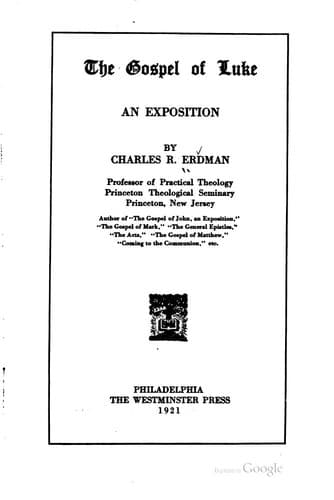
The Gospel of Luke, an expositionErdman, Charles Rosenbury
Religion
The Gospel of Luke, an exposition
Erdman, Charles Rosenbury
Bible. Luke -- Commentaries
The Master lovingly reassured his great herald by sending back the report
of the mighty works which he was accomplishing. John was already familiar
with these acts but the recital must have dispelled his fears. Jesus
sympathizes with us also in our hours of darkness, but his relief usually
consists in reminding us of facts we already know concerning his power and
love and presence and the truths of his written Word.
Jesus, however, does not praise us for our doubts; he sent to John a
gentle and loving rebuke: “And blessed is he, whosoever shall find no
occasion of stumbling in me.” This benediction he pronounces upon all who
in spite of darkness, imprisonment, delay, and mystery still confidently
put their trust in him.
It was upon this occasion when John seems to have failed that Jesus
pronounced upon him unparalleled praise, declaring that “among them that
are born of women there is none greater than John.” He vindicated this
deliberate judgment and thereby, showed wherein true greatness lies. He
spoke first of the character of John and then of his career. He praised
the man and then the messenger. He described his moral and then his
official greatness.
His expression as to the character of John is voiced by two questions, to
each of which a negative answer of course must be given: first, “What went
ye out into the wilderness to behold? a reed shaken with the wind?” Surely
true greatness does not lie in the moral cowardice which bends before
every breeze; quite on the contrary, John was like a rock which no storm
could move.
Then there was a second question: “What went ye out to see? a man clothed
in soft raiment?” Surely greatness does not lie along the line of
self-gratification and indulgence. John endured all hardships and was
oblivious to all human delights because he was so devoted to his divine
task. Courage and consecration—these constitute prime factors in moral
greatness.
The real greatness of John consisted, however, in his mission. Jesus
declared that he was the messenger whom Malachi had predicted should
prepare the way of the Lord. Other prophets had appeared and had predicted
the coming of the Messiah. It was given to John not only to declare that
the Christ would come, but to point to him and to say, “Behold, the Lamb
of God! ... this is the Son of God.” No greater dignity had ever been
conferred upon a human soul; and no higher privilege can now be enjoyed
than that of turning the thoughts and hearts of men to Jesus Christ, the
Saviour of the world. The present followers of Christ have a larger
knowledge of him than was possessed by John. What their relative positions
will be in the glory of the perfected Kingdom will depend upon the
comparative faithfulness with which they serve their Master.
Public-domain text, read in full here on John Shaqi.
Reviews
Reviews
No reviews yet
Be the first to share your thoughts on this work.
Elsewhere in the archive
Join the Discussion
Join the discussion
Sign in to leave a comment or review.
Sign InorCreate an account