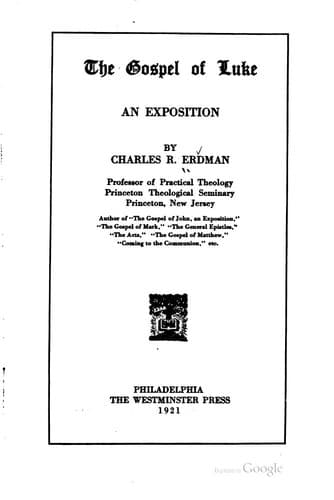
The Gospel of Luke, an expositionErdman, Charles Rosenbury
Religion
The Gospel of Luke, an exposition
Erdman, Charles Rosenbury
Bible. Luke -- Commentaries
Jesus, however, rebuked him, and said, “Forbid him not: for he that is not
against you is for you.” After all, there is no place for bigotry among
the followers of Christ. We may love and admire our sect or society, but
we are never to stop the work of a fellow Christian however much he may
differ from us. There are only two questions to ask: First, Is he casting
out demons? That is to say, is he really accomplishing good? Second, Is he
doing the work in the name of a divine, crucified, risen Christ? If so,
“Forbid him not.” We must not expect all Christians to repeat the same
creed or to enjoy the same ritual or to accept the same polity or to
employ the same methods of work. We should remember the word of the
Master, “He that is not against you is for you.”
V. THE JOURNEYS TOWARD JERUSALEM. CHS. 9:51 TO 19:28
A. The First Stages. Ch. 9:51 to 13:21
1. The Inhospitable Samaritans. Ch. 9:51-56
51 And it came to pass, when the days were well-nigh come that he
should be received up, he stedfastly set his face to go to
Jerusalem, 52 and sent messengers before his face: and they went,
and entered into a village of the Samaritans, to make ready for
him. 53 And they did not receive him, because his face was _as
though he were_ going to Jerusalem. 54 And when his disciples
James and John saw _this_, they said, Lord, wilt thou that we bid
fire to come down from heaven, and consume them? 55 But he turned,
and rebuked them. 56 And they went to another village.
The record of the last journeys of our Lord toward Jerusalem forms a
unique feature in the Gospel of Luke. In the other Gospels some of these
incidents are included but they occupy only one or two chapters; here,
however, they fill ten chapters with events most of which are no where
else related.
The direction of the journeying was first eastward through the borders of
Galilee and Samaria, then across the Jordan and then southward through the
region of Perea. This region is not so designated in the Bible but is
described by the phrase, “beyond the Jordan,” and as most of these
incidents occurred there, this period of the life of Jesus is commonly
called his “Perean ministry.” Luke here emphasizes the divine prevision
and at the same time the human courage of our Lord. He indicates that
Jesus saw plainly his coming death and also his glorious ascension, but
that he unfalteringly moved forward to the intervening agonies of the
cross.
Public-domain text, read in full here on John Shaqi.
Reviews
Reviews
No reviews yet
Be the first to share your thoughts on this work.
Elsewhere in the archive
Join the Discussion
Join the discussion
Sign in to leave a comment or review.
Sign InorCreate an account