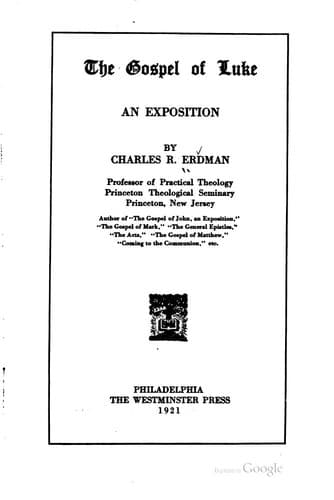
The Gospel of Luke, an expositionErdman, Charles Rosenbury
Religion
The Gospel of Luke, an exposition
Erdman, Charles Rosenbury
Bible. Luke -- Commentaries
33 No man, when he hath lighted a lamp, putteth it in a cellar,
neither under the bushel, but on the stand, that they which enter
in may see the light. 34 The lamp of thy body is thine eye: when
thine eye is single, thy whole body also is full of light; but
when it is evil, thy body also is full of darkness. 35 Look
therefore whether the light that is in thee be not darkness. 36 If
therefore thy whole body be full of light, having no part dark, it
shall be wholly full of light, as when the lamp with its bright
shining doth give thee light.
The first of these two discourses, vs. 14-26, was given by Jesus in reply
to the charge that he wrought his miracles by Satanic power, v. 15; the
second, vs. 29-36, was an answer to the demand that he should compel his
enemies to believe in him by giving them “a sign from heaven,” v. 16.
Jesus had just cast out a demon. His enemies did not attempt to deny that
a miracle had been performed; but, in order to discredit him with the
people, they explained the miracle on the ground that Jesus must be in
league with the Devil. He replied by showing the absurdity of suggesting
that the Devil was casting out devils, or “demons,” for in that case his
power would be like a kingdom “divided against itself” and so certain to
be “brought to desolation,” or like a house thus divided and sure to fall.
Vs. 17, 18. He then turned the charge against themselves: some of their
countrymen claimed the power to cast out demons; Jesus did not discuss the
reality of these reputed cures but pointedly asked by what power they were
effected; is it also demonic power? v. 19. Jesus then declared definitely
that his miracles were being wrought by divine power and that their
character was a certain proof that he was representing not the kingdom of
the Devil but “the kingdom of God.” V. 20. Instead of aiding the Devil, he
was despoiling him. He described the Devil as though a strong man, fully
armed and guarding his goods, but Jesus himself was a “stronger than he,”
and was taking away his armor and delivering his captives by miracles of
grace. Vs. 21, 22. In this conflict there can be no neutrality; one must
be on the side either of the Devil or of Christ. V. 23.
Jesus then rebuked his enemies by the parable of the Unclean Spirit. The
demon of unbelief had once possessed the Jews, and had been manifested in
the form of idolatry; it had been cast out, but it had returned with more
terrible manifestations of hypocrisy, covetousness, hatred, fanaticism,
and pride. Such had been the fate of the nation; and such is the
experience of an individual who turns from sin and rebels against Satan
but fails to accept the Lordship of Christ. The empty heart is in peril.
Reformation is not regeneration. One must beware of the demon of unbelief.
Vs. 24-26.
Public-domain text, read in full here on John Shaqi.
Reviews
Reviews
No reviews yet
Be the first to share your thoughts on this work.
Elsewhere in the archive
Join the Discussion
Join the discussion
Sign in to leave a comment or review.
Sign InorCreate an account