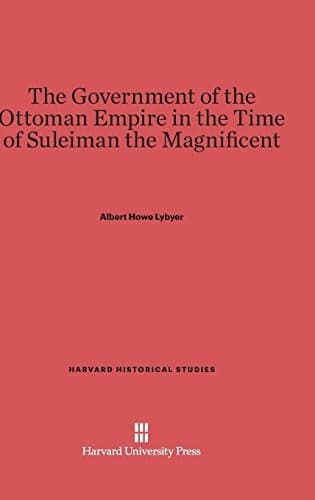
The government of the Ottoman Empire in the time of Suleiman the MagnificentLybyer, Albert Howe
History
The government of the Ottoman Empire in the time of Suleiman the Magnificent
Lybyer, Albert Howe
Süleyman I, Sultan of the Turks, 1494 or 1495-1566; Turkey -- Politics and government
But here the _Mufti_ Jemali intervened decisively. He had readily given
a _fetva_ authorizing the extermination of the heretics as in accordance
with the Sacred Law, and he was later to sanction the Persian and the
Egyptian wars. In this case, Selim, it is said, deceived him by a
hypothetical question into giving a response which might be interpreted
to authorize the forcible conversion of the Christians. After the order
was issued, however, Jemali, awakened to the situation, put the Greek
Patriarch in possession of a sufficient defence by showing him that the
Sacred Law provided that Christians who had accepted Mohammedan rule and
agreed to pay _kharâj_ and _jizyeh_ (land tribute and poll-tax) were,
aside from certain regulations, to be left unmolested in the exercise
of their religion. This provision the Patriarch, as instructed by the
_Mufti_, claimed to be an irrevocable and eternal compact; therefore,
he urged, since Selim’s intention was contrary to it, his purpose
was unlawful and must be abandoned. The argument prevailed, and the
Christians were not disturbed as to their faith.
It may be remarked that Selim’s idea was an excellent one from the
point of view of statesmanship, and would, in the end, have resulted
in a great advantage to the Moslem Institution. As pointed out in the
first chapter, the Christian churches in the Ottoman Empire constituted
a group of organizations that were parallel and rival to the Moslem
Institution; hence their removal would have left it a free field. Whether
its unopposed action would, in the long run, have been an advantage to
the empire and to the world is a matter for speculation which would be
out of place here; but as a state the Ottoman Empire would have been
notably unified by the clearing away of these institutions. They were
old, strong, and of a tenacious vitality; in them centered the hopes and
aspirations of the subject Christians; while they persisted, complete
amalgamation of the population was impossible; they were to keep alive a
sentiment of nationality and separatism that three centuries later was
to break off great sections from the empire. It seems clear, then, that,
had Selim been able to carry out his purpose, the history of the Levant
since his time would have been very different from what it has been. But
the _Mufti_, as guardian of the Sacred Law, was right. The position of
the Christian subjects rested on a firm constitutional foundation.[671]
The Prophet Mohammed himself, nine centuries before Selim, had made the
religious and social unity of the Ottoman Empire forever impossible.
He had also made political unity impossible at that time; for in the
sixteenth century political, apart from religious, unity was not
understood in either the East or the West. Only in the twentieth century
was Turkey to arrive at a new hope of political unity through an attempt
to remove religious differences from a position of great influence upon
the state.
Public-domain text, read in full here on John Shaqi.
Reviews
Reviews
No reviews yet
Be the first to share your thoughts on this work.
Elsewhere in the archive
Join the Discussion
Join the discussion
Sign in to leave a comment or review.
Sign InorCreate an account