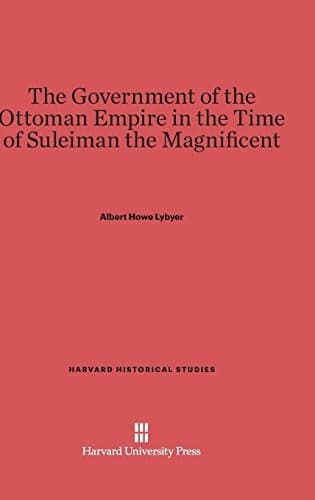
The government of the Ottoman Empire in the time of Suleiman the MagnificentLybyer, Albert Howe
History
The government of the Ottoman Empire in the time of Suleiman the Magnificent
Lybyer, Albert Howe
Süleyman I, Sultan of the Turks, 1494 or 1495-1566; Turkey -- Politics and government
Distinction and membership in the institution proper rested upon birth
in the case of the descendants of Mohammed, upon profession of piety and
special religious service in the case of the dervishes, but upon learned
knowledge of the Sacred Law in all positions of public influence and
importance. The three highly-honored classes of teachers, jurists, and
judges were trained in the same superbly-planned educational system, in
the same text-books and the same ideas. Whether in Constantinople or
Cairo, the Crimea or Algiers, Budapest or Bagdad, old, grave, wise, and
learned professors, jurists, and judges taught, interpreted, and enforced
the same wide-reaching and changeless Sacred Law. As teachers, the
_Ulema_ conveyed to children and youth, in impressible years, that which
they had themselves received. The same learned persons, after fixing
each part of the whole round of legal studies in their minds by periods
of teaching, were advanced to places where they dealt not with boys, but
with men, where their work affected not the fortunes of individuals,
but the destinies of the empire. Yet their influence was exerted
strenuously in the same direction throughout, to impress and perpetuate
the changeless body of ideas in the Sacred Law. Professors, jurists,
and judges alike were, in all that they did and throughout their lives,
fundamentally teachers. The _Ulema_ taught all the Moslems of the empire,
from the young child to the aged sultan. They maintained schools for the
young; places of worship, courts, and offices of consultation for adults.
Every important officer of administrative government had a judge and a
_mufti_ at his elbow. Not only was the sultan himself in close relations
with the _Kaziaskers_ and the _Mufti,_ but he had always a spiritual
adviser to whom he showed great deference, and who bore the significant
title of the sultan’s _Hoja_, or teacher. There was an aspect in which
the Moslem Institution, based upon the Moslem population of the empire,
fitted the government as hand fits glove. This figure, moreover, can be
pressed beyond the mere comparison of shape; the hand is of much the same
efficiency with or without the glove, while the glove is useless without
the hand; furthermore, the hand may live to wear a succession of gloves.
CHAPTER VIII
COMPARISON OF THE TWO GREAT INSTITUTIONS
The Ottoman Ruling Institution, and the Moslem Institution of the Ottoman
Empire might be compared, contrasted, and reflected upon at great length.
In this discussion, however, it must suffice to select and comment upon a
few of their salient likenesses, differences, and interactions, without
attempting to separate such features sharply.
LIKENESSES
Public-domain text, read in full here on John Shaqi.
Reviews
Reviews
No reviews yet
Be the first to share your thoughts on this work.
Elsewhere in the archive
Join the Discussion
Join the discussion
Sign in to leave a comment or review.
Sign InorCreate an account