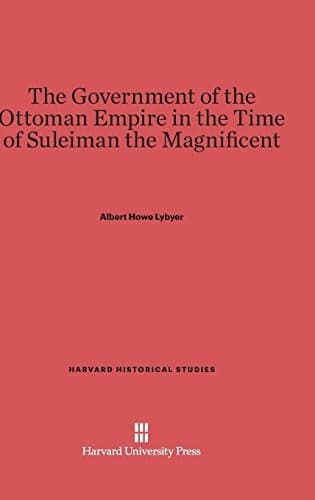
The government of the Ottoman Empire in the time of Suleiman the MagnificentLybyer, Albert Howe
History
The government of the Ottoman Empire in the time of Suleiman the Magnificent
Lybyer, Albert Howe
Süleyman I, Sultan of the Turks, 1494 or 1495-1566; Turkey -- Politics and government
In the absence of an elaborate slave system in India, there was not the
steady public machinery of conversion which operated powerfully in the
Ottoman Empire. Furthermore, it would seem that before the reign of
Aurangzeb no emperor cared to promote conversion to Islam by financial
or political rewards. Akbar, in fact, removed the jizyeh, or poll-tax,
which had previously, as in all other truly Moslem lands until recent
times, laid special burdens upon unbelievers, and the tax was not
reimposed until the time of Aurangzeb. Akbar also forbade the enslavement
of captives and of their wives and children. For a century, therefore,
the government lent little encouragement to change of faith. Down to the
accession of Aurangzeb there was a clear contrast between Ottoman and
Mogul policy in the attitude toward the Moslem religion: the Moguls held
far less than the Ottomans to the idea of the conquest of the world for
Islam, or to the conversion of unbelievers, as an object of governmental
endeavor. Aurangzeb alone had such zeal as characterizes the average
descendant of Osman; he desired no infidels in his service, and regarded
the Deccan as the _Dar-ul-harb_ which he wished to make part of the
_Dar-ul-Islam_. There can be no doubt, however, that under all the Mogul
emperors the social pressure usual in Moslem lands continued to encourage
conversion privately, while the slavery which Islam normally sanctions
was also contributing to the increase of the faithful. Moreover, it is
not likely that all the officers of the liberal emperors were as tolerant
and as indifferent to Moslem progress as were their superiors.
THE ARMY
At Delhi, as at Constantinople, no sharp line could be drawn separating
government and army. The Mogul conquest was achieved by an army, and
the army became a government. Amalgamation with older systems of course
introduced groups of under-officials who had no military duties; but
those who would be great had to be capable of military command, men who
might be familiar with the pen but who must know how to wield the sword.
The Mogul army organization seems, in the midst of confused testimonies,
to have borne a considerable resemblance to that of the Ottomans. The
emperor was commander-in-chief, and as late as Aurangzeb regularly
commanded in person in great campaigns. He had a personal army of
12,000 to 15,000 paid infantry and 12,000 to 40,000 paid cavalry.
These corresponded in number and function, but not at all in political
importance, to the Janissaries and _Spahis_ of the Porte among the
Ottomans. In great campaigns the standing army was supported by the
feudal cavalry, estimated at from 200,000 to 400,000, and by indefinite
numbers of irregular infantry, drawn from a mass estimated at four
millions. The army was strong in artillery, and possessed in trained
elephants a force of which the Ottomans could not make use.
Public-domain text, read in full here on John Shaqi.
Reviews
Reviews
No reviews yet
Be the first to share your thoughts on this work.
Elsewhere in the archive
Join the Discussion
Join the discussion
Sign in to leave a comment or review.
Sign InorCreate an account