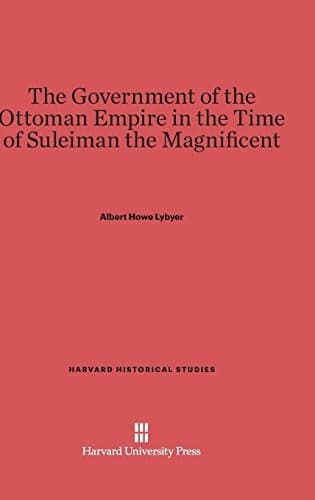
The government of the Ottoman Empire in the time of Suleiman the MagnificentLybyer, Albert Howe
History
The government of the Ottoman Empire in the time of Suleiman the Magnificent
Lybyer, Albert Howe
Süleyman I, Sultan of the Turks, 1494 or 1495-1566; Turkey -- Politics and government
TÜRCKEN, BERNARDIN. Getrewe und wolmeynende kurtze Erinnerung von der
Türcken Ordnung, in iren Kriegen vñ Veldtschlachten. Burgel, 1542.
UBICINI, A[BDOLONYME]. État présent de l’empire ottoman. Paris, 1876.
URBINUS, THEOPHILUS. Türckisches Städt-Büchlein. Nuremberg, 1664.
URSU, J[ON]. La politique orientale de François I (1515-1547). Paris,
1908.
VAMBÉRY, HERMANN (ARMINIUS). Die primitive Cultur des turko-tatarischen
Volkes auf grund sprachlicher Forschungen. Leipsic, 1879.—See p. 306.
—— Uigurische Sprachmonumente und das Kudatku Bilik. Innsbruck, 1870.—See
p. 306.
VENIER, MAFFEO. Relazione, 1579, 1587. In Alberi’s _Relazione_, 3d
series, i. 437-468, ii. 295-307. Florence, 1840-1844.
VIAGGI fatti da Vinetia, alla tana ... in Costantinopoli. Venice,
1543.—Contains Libri Tre, etc., of RAMBERTI, _q. v._
YOUSSOUF FEHMI. Histoire de la Turquie. Paris, 1909.
YUSEF KHASS HAJIL. Kudatku Bilik (Art of Government). See VAMBÉRY,
Uigurische Sprachmonumente, etc.
ZANE, MATTEO. Relazione, 1594. In Alberi’s _Relazione_, 3d series, iii.
381-444. Florence, 1855.
ZEN (or ZENO), PIETRO. Itinerario, 1523. In Fulin’s _Diarii_, 104-136.
Venice, 1881.
—— Relazione, 1524, 1530. In Alberi’s _Relazione_, 3d series, iii. 93-97,
119-122. Florence, 1855.
ZINKEISEN, J. W. Geschichte des osmanischen Reiches in Europa. 7 vols.
and Index, Hamburg and Gotha, 1840-1863.—See p. 321.
FOOTNOTES
[1] Cahun, _Introduction à l’Histoire de l’Asie_, 90.
[2] The West was much concerned in the sixteenth century with the
problem of ascertaining the origin of the Turks. Balbus gives an idea
how difficult it was to reach a definite opinion: “Some count the Turks
among the Asiatic Sarmatians, and say that they were expelled by their
neighbors from the Caspian mountains into Persia, and descended into
Asia Minor. Others, following the name, perhaps, think that this people
had its beginning in Turce, a great and opulent city of the Persians.
Others consider them the progeny of the Parthians. Some think the Turks
had their origin in Arabia, and some in Syria. But it is more likely that
they were Scythians by origin, and (as we said above) from the foot of
Mount Caucasus, and that they formerly inhabited vast deserts.” See also
Knolles, 1-2.
[3] Keane, _Man, Past and Present_, 268, 314-315. Holdich (in
_Encyclopaedia Britannica_, 11th ed., ii. 749 b) says, “As ethnographical
inquiry advances the Turk appears to recede from his Mongolian affinities
and to approach the Caucasian.” Keene (_Turks in India_, 1 ff.) is
inclined to consider the Turks a mere mixture of Mongols with Caucasians.
So bald a theory does not account for the group of Turkish languages.
[4] Keane, 267.
[5] _Ibid._ 317.
[6] _Ibid._ 322; Hammer, _Geschichte_, i. 3.
[7] Keane, 322; Hammer, _Geschichte_, i. 2; etc.
[8] Hammer, _Geschichte_, i. 1. This fact, known to Knolles (p. 2),
seems to have escaped the attention of Sir Charles Eliot (_Encyclopaedia
Britannica_, 11th ed., xxvii. 470 d).
Public-domain text, read in full here on John Shaqi.
Reviews
Reviews
No reviews yet
Be the first to share your thoughts on this work.
Elsewhere in the archive
Join the Discussion
Join the discussion
Sign in to leave a comment or review.
Sign InorCreate an account