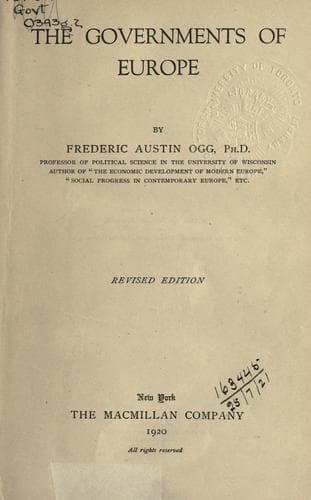
Europe -- Politics and government; Political science
to be pensioned and to be elevated to the peerage.[179]
[Footnote 176: American Commonwealth, I., 135.]
[Footnote 177: Parliament, 140-141.]
[Footnote 178: See p. 112.]
[Footnote 179: On the officers of the House of
Commons see Lowell, Government of England, I.,
Chap. 12; on the speakership, Redlich, Procedure of
the House of Commons, II., 131-171; Graham, The
Mother of Parliaments, 119-134; MacDonaugh, The
Book of Parliament, 115-132; Porritt, Unreformed
House of Commons, I., Chaps. 21-22; A. I. Dasent,
The Speakers of the House of Commons from the
Earliest Times to the Present Day (New York, 1911);
and G. Mer, Les speakers: etude de la fonction
presidentielle en Angleterre et aux Etats-Unis
(Paris, 1910).]
*127. Quorum.*--As fixed by a resolution of 1640, a quorum for the
transaction of business in the Commons is forty. If at any time during
a sitting the attention of the Speaker is directed to the fact that
there are not forty members present, the two-minute sand-glass which
stands upon the Clerk's table is inverted and the members are summoned
from all portions of the building as for a division. At the close of
the allotted two minutes the Speaker counts the members present, and
if there be not forty the House adjourns until the time fixed for the
next regular sitting. Except upon occasions of special interest, the
number of members actually occupying the benches is likely to be less
than two hundred, although most of the remaining members are within
the building or, in any case, not far distant.
Public-domain text, read in full here on John Shaqi.
Reviews
Reviews
No reviews yet
Be the first to share your thoughts on this work.
Elsewhere in the archive
Join the Discussion
Join the discussion
Sign in to leave a comment or review.
Sign InorCreate an account