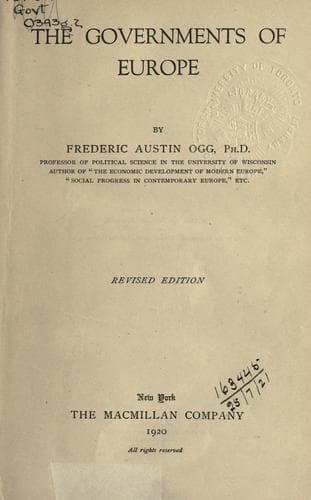
Europe -- Politics and government; Political science
*131. Sittings and Attendance.*--It is required that the two houses of
Parliament shall be convened invariably together, and one may not be
prorogued without the other. The actual sittings of the Lords are,
however, very much briefer and more leisurely than are those of the
Commons. Normally the upper chamber meets but four times a week--on
Mondays, Thursdays, and Fridays at 4.30 o'clock and on Tuesdays at
5.30. By reason of lack of business or indisposition to consume time
in the consideration of measures whose eventual enactment is assured,
sittings not infrequently are concluded within an hour, although, of
course, there are occasions upon which the chamber deliberates
seriously and at much length. A quorum for the transaction of business
is fixed at the number three; although it is but fair to observe
that if a division occurs upon a bill and it is found that there are
not thirty members present the question is declared not to be
decided. Save upon formal occasions and at times when there is under
consideration a measure in whose fate the members are immediately
interested, attendance is always meager. There are members who after
complying with the formalities incident to the assumption of a seat,
rarely, and in some instances never, reappear among their colleagues.
It thus comes about that despite the fact that nominally the House of
Lords is one of the largest of the world's law-making assemblies, the
chamber exhibits in reality little of the unwieldiness ordinarily
characteristic of deliberative bodies of such magnitude. The
efficiency of the chamber is more likely to be impaired by paucity of
attendance than otherwise.
Public-domain text, read in full here on John Shaqi.
Reviews
Reviews
No reviews yet
Be the first to share your thoughts on this work.
Elsewhere in the archive
Join the Discussion
Join the discussion
Sign in to leave a comment or review.
Sign InorCreate an account