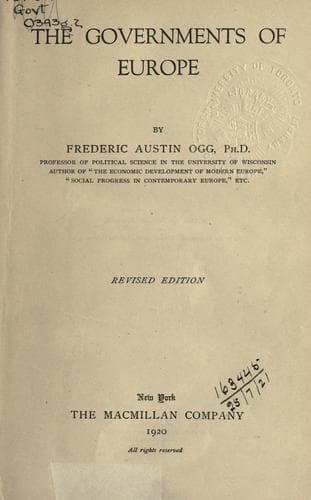
Europe -- Politics and government; Political science
*140. Public Bills: First and Second Readings.*--The steps through which
a public bill, whether introduced by the Government or by a private
member, must pass in the Commons are still numerous, but by the
reduction of some of them to sheer formalities which involve neither
debate nor vote the actual legislative process has been made much more
expeditious than once it was. The necessary stages in the enactment of
a bill in either house are, as a rule, five: first reading, second
reading, consideration by committee, report from committee, and third
reading. Formerly the introduction of a measure involved almost
invariably a speech explaining at length the nature of the proposal,
followed by a debate and a vote, sometimes consuming, in all, several
sittings. Nowadays only very important Government bills are introduced
in this manner. In the case of all other bills the first reading has
become a mere formality, involving nothing more than a motion on the
part of a member, official or private, for permission to bring in a
measure and the giving of leave by the House, almost invariably
without discussion. Upon all measures save the most important
Government projects, opportunity for debate is first afforded at the
second reading, although the discussion at this stage must relate to
general principles rather than to details. By the adoption of a motion
that the bill be read a second time "this day six months" (or at some
other date falling beyond the anticipated limits of the session) a
measure may at this point be killed.
Public-domain text, read in full here on John Shaqi.
Reviews
Reviews
No reviews yet
Be the first to share your thoughts on this work.
Elsewhere in the archive
Join the Discussion
Join the discussion
Sign in to leave a comment or review.
Sign InorCreate an account