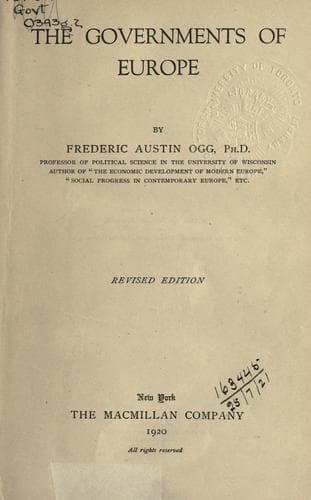
Europe -- Politics and government; Political science
[Footnote 201: The procedure involved in the
handling of money bills is described in Lowell,
Government of England, I., Chap. 14; Anson, Law and
Custom of the Constitution, I., 268-281; Walpole,
Electorate and Legislature, Chap. 7; Todd,
Parliamentary Government, II., 186-271; Ilbert,
Parliament, Chap. 4; Redlich, Procedure of the
House of Commons, III., 113-174; May, Treatise on
the Law, Privileges, Proceedings, and Usage of
Parliament, Chap. 21. See also E. Porritt,
Amendments in the House of Commons Procedure since
1881, in _American Political Science Review_, Nov.,
1908. Among numerous works on taxation in England
the standard authority is S. Dowell, History of
Taxation and Taxes in England from the Earliest
Times to the Year 1885, 4 vols. (2d ed., London,
1888).]
*144. Private Bills: Nature and Procedure.*--In the matter of (p. 137)
procedure there is no distinction between a Government bill and a
private member's bill. Both are public bills. But a private bill is
handled in a manner largely peculiar to itself. A public bill is one
which affects the general interests of the state, and which has for
its object presumably the promotion of the common good. A private bill
is one which has in view the interest of some particular locality,
person, or collection of persons. The commonest object of private
bills is to enable private individuals to enter into combination to
undertake works of public utility--the building of railways or
tramways, the construction of harbors or piers, the draining of
swamps, the supplying of water, gas, or electricity, and the embarking
upon a wide variety of other enterprises which in the United States
would be regulated chiefly by state legislatures and city councils--at
their own risk and, in part at least, for their own profit. All
private bills originate in petitions, which must be submitted in
advance of the opening of the session during which they are to be
considered. Their presentation and the various stages of their
progress are governed by very detailed and stringent regulations, and
fees are required from both promoters and opponents, so that the
enactment of a private bill of importance becomes for the parties
directly concerned an expensive process, and for the Exchequer a
source of no inconsiderable amount of revenue.
Public-domain text, read in full here on John Shaqi.
Reviews
Reviews
No reviews yet
Be the first to share your thoughts on this work.
Elsewhere in the archive
Join the Discussion
Join the discussion
Sign in to leave a comment or review.
Sign InorCreate an account