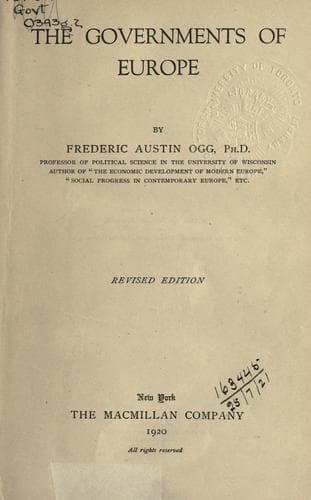
Europe -- Politics and government; Political science
[Footnote 203: Government of England, I., 385. On
private bill legislation see Lowell, I., Chap. 20;
Anson, Law and Custom of the Constitution, I,
291-300; May, Treatise on the Law, Privileges,
Proceedings, and Usage of Parliament, Chaps. 24-29;
Courtney, Working Constitution of the United
Kingdom, Chap. 18; MacDonaugh, The Book of
Parliament, 398-420. The standard treatise upon the
subject is F. Clifford, History of Private Bill
Legislation, 2 vols. (London, 1885-1887). A recent
book of value is F. H. Spencer, Municipal Origins;
an Account of English Private Bill Legislation
relating to Local Government, 1740-1835, with a
Chapter on Private Bill Procedure (London, 1911).]
VII. THE CONDUCT OF BUSINESS IN THE TWO HOUSES
"How can I learn the rules of the Commons?" was a question once put by
an Irish member to Mr. Parnell. "By breaking them," was the
philosophic reply. Representing, as it does, an accumulation through
centuries of deliberately adopted regulations, interwoven and overlaid
with unwritten custom, the code of procedure by which the conduct of
business in the House of Commons is governed is indeed intricate (p. 139)
and forbidding. Lord Palmerston admitted that he never fully mastered
it, and Gladstone was not infrequently an inadvertent offender against
the "rules of the House." Prior to the nineteenth century the rules
were devised, as is pointed out by Anson, with two objects in view: to
protect the House from hasty and ill-considered action pressed forward
by the king's ministers, and to secure fair play between the parties
in the chamber and a hearing for all. It was not until 1811 that
business of the Government was permitted to obtain recognized
precedence on certain days; but the history of the procedure of the
Commons since that date is a record of (1) the general reduction of
the time during which private members may indulge in the discussion of
subjects or measures lying outside the Government's legislative
programme, (2) increasing limitation of the opportunity for raising
general questions at the various stages of Government business, and
(3) the cutting down of the time allowed for discussing at all the
projects to which the Government asks the chambers' assent.[204]
[Footnote 204: Anson, Law and Custom of the
Constitution, I., 253.]
Public-domain text, read in full here on John Shaqi.
Reviews
Reviews
No reviews yet
Be the first to share your thoughts on this work.
Elsewhere in the archive
Join the Discussion
Join the discussion
Sign in to leave a comment or review.
Sign InorCreate an account