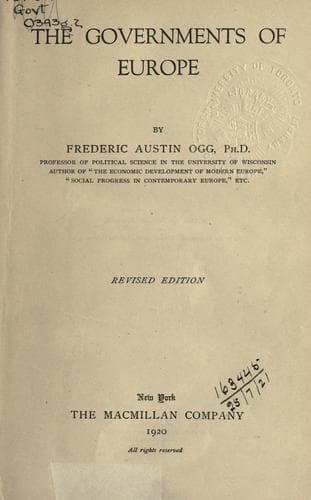
Europe -- Politics and government; Political science
*154. The Liberals and Reform.*--The political history of this second
great era of Whig ascendancy falls into some four or five stages. The
first, extending from the accession of the Grey ministry in 1830 to
the parliamentary elections of 1841, was an epoch of notable reforms,
undertaken and carried through mainly by the Whigs, with the
co-operation of various radical elements and of discontented Tories.
This was the period of the first Reform Act (1832), the emancipation
of slaves in the British colonies (1833), the beginning of
parliamentary appropriations for public education (1833), the Factory
Act of 1833, the New Poor Law (1834), the Municipal Corporations Act
(1835), and a number of other measures designed to meet urgent demands
of humanity and of public interest. This was the time, furthermore, at
which the party nomenclature of later days was brought into use. The
name Whig was superseded altogether by that of Liberal, while the name
Tory, though not wholly discontinued in everyday usage, was replaced
largely by the term Conservative.[213] The Liberals were in these
years peculiarly the party of reform, but it must not be inferred that
the Conservatives resisted all change or withheld support from all
measures of amelioration.
[Footnote 213: The name Conservative was employed
by Canning as early as 1824. Its use was already
becoming common when, in January, 1835, Peel, in
his manifesto to the electors of Tamworth,
undertook an exposition of the principles of what
he declared should be known henceforth as the
Conservative--not the Tory--party.]
Public-domain text, read in full here on John Shaqi.
Reviews
Reviews
No reviews yet
Be the first to share your thoughts on this work.
Elsewhere in the archive
Join the Discussion
Join the discussion
Sign in to leave a comment or review.
Sign InorCreate an account