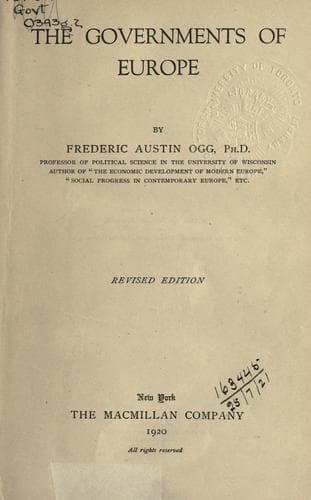
Europe -- Politics and government; Political science
*169. Significance of "Liberal" and "Conservative."*--Of the four
political parties of Great Britain to-day one, the Irish Nationalist,
is localized in Ireland and has for its essential purpose the
attainment of the single end of Irish Home Rule;[230] another, the
Labor party, is composed all but exclusively of workingmen, mainly
members of trade-unions, and exists to promote the interests of the
laboring masses; while the two older and more powerful ones, the
Liberal and the Conservative or Unionist, are broadly national in
their constituencies and well-nigh universal in the range of their
principles and policies. It is essential to observe, however, that
while the programme of the Nationalists is, at least to a certain
point, perfectly precise, and that of the Laborites is hardly less so,
there is no longer, despite the heat of recurring electoral and
parliamentary combats, much that is fundamental or permanent in the
demarcation which sets off the two major parties the one against the
other. Even the names "Liberal" and "Conservative" denote in reality
much less than might be supposed. During the generation which began
with the Reform Act of 1832 the Liberals, indeed, extended the
franchise to the middle classes, reformed the poor law, overhauled the
criminal law, introduced a new and more satisfactory scheme of
municipal administration, instituted public provision for elementary
education, enacted statutes to safeguard the public health, removed
the disabilities of dissenters, and assisted in the overthrow of the
protective system. But if the Conservatives of the period 1830-1870
played, in general, the role implied by their party designation, their
attitude none the less was by no means always that of obstructionists,
and in the days of the Disraelian leadership they became scarcely less
a party of reform than were their opponents. Beginning with the Reform
Act of 1867, a long list of progressive and even revolutionizing
measures must be credited to them, and in late years they and the
Liberals have vied in advocating old age pensions, factory
legislation, accident insurance, housing laws, and other sorts of
advanced and remedial governmental action. The differences which
separate the two parties are not so much those of principle or of (p. 163)
political dogma as those of policy respecting immediate and particular
measures, and especially those of attitude toward certain important
organizations and interests. The Liberals assert themselves to be more
trustful of the people and more concerned about the popular welfare,
but the Conservatives enter a denial which possesses plausibility. It
is probably true that the Liberals have fostered peace and economy
with more resoluteness than have their rivals, yet so far as
expenditures go the Liberal administration to-day is laying out more
money than was ever laid out by a Conservative government in time of
peace. The Liberals are seemingly more regardful of the interests of
Public-domain text, read in full here on John Shaqi.
Reviews
Reviews
No reviews yet
Be the first to share your thoughts on this work.
Elsewhere in the archive
Join the Discussion
Join the discussion
Sign in to leave a comment or review.
Sign InorCreate an account