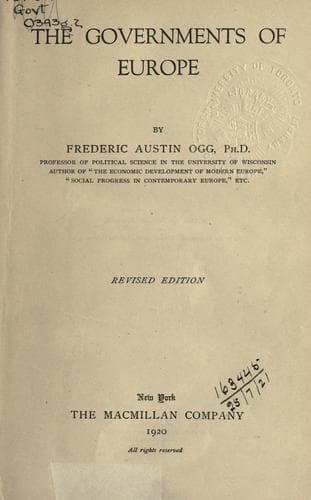
Europe -- Politics and government; Political science
*171. Party Composition.*--Both of the great parties as constituted
to-day possess substantial strength in all portions of the kingdom
save Ireland, the Liberals being in the preponderance in Scotland,
Wales, and northern England, and the Conservatives in the south and
southwest. Within the Conservative ranks are found much the greater
portion of the people of title, wealth, and social position; nearly
all of the clergy of the Established Church, and some of the
Dissenters; a majority of the graduates of the universities[236] and
of members of the bar; most of the prosperous merchants,
manufacturers, and financiers; a majority of clerks and approximately
half of the tradesmen and shopkeepers; and a very considerable mass,
though not in these days half, of the workingmen. During the second
half of the nineteenth century the well-to-do and aristocratic (p. 165)
Whig element in the Liberal party was drawn over, in the main, to the
ranks of the Conservatives,[237] and to this day the Liberal party
contains but a small proportion of the rank and wealth of the kingdom.
It is pre-eminently an organization of the middle and popular classes.
[Footnote 236: At the election of 1906, 21,505 of
the 25,771 votes recorded in the university
constituencies were cast for Unionist candidates.
Since 1885 not a Liberal member has been returned
from any one of the universities.]
[Footnote 237: The defection was largest at the
time of the Liberal Unionist secession in 1886.]
Public-domain text, read in full here on John Shaqi.
Reviews
Reviews
No reviews yet
Be the first to share your thoughts on this work.
Elsewhere in the archive
Join the Discussion
Join the discussion
Sign in to leave a comment or review.
Sign InorCreate an account