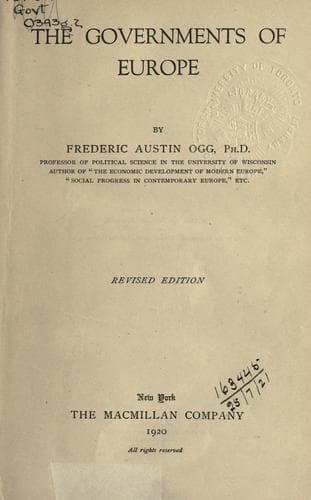
Europe -- Politics and government; Political science
*181. Special Borough Arrangements.*--The smaller boroughs, having no
separate commissions of the peace, are for purposes of criminal
justice merely portions of the counties in which they lie. In many of
the larger ones, however, there have been set up judicial arrangements
in consequence of which the borough is withdrawn from the county
jurisdiction. Some have a commission of the peace but no quarter
sessions. In them the justices can exercise, in addition to the usual
functions of police magistrate, only a summary jurisdiction. Others
have a court of quarter sessions; though it is to be observed that
where this tribunal exists its work is performed actually by the
recorder, a barrister appointed by the crown and paid by the borough.
III. THE HIGHER COURTS
*182. Supreme Court of Judicature: the High Court.*--The higher
tribunals within the judicial system were once numerous and extremely
complex. As reconstituted, however, by the great Judicature Act of
1873, which, together with an Amending Act, took effect near the close
of 1875, they have acquired a considerable degree of orderliness and
even of simplicity. The measure of 1873 abolished the appellate
jurisdiction of the House of Lords, but the Amending Act three years
later rescinded this modification, and, as has been explained
elsewhere, the House of Lords is still a court of very great
importance.[251] Aside from the Lords, however, the higher courts of
the realm--the Chancery, the three great Common Law courts, the
Admiralty, Probate, and Divorce courts, and the intermediate courts of
appeal from these tribunals of first instance--were consolidated by
the legislation of 1873-1875 to form one grand organization, the
Supreme Court of Judicature, which was thereupon cut into two
branches, the High Court of Justice and the Court of Appeal. The High
Court of Justice was assigned a general jurisdiction, civil and
criminal, as a court of first instance and also as a court of (p. 174)
appeal from inferior courts. Its jurisdiction represents essentially
the aggregate of jurisdictions of the tribunals which it superseded,
and the various divisions into which it falls perpetuate in a measure
the names and functions of those tribunals. There were originally five
of these divisions. To-day there are three: Chancery, King's Bench
(with which the Common Pleas and Exchequer divisions were united by
order in council of December 16, 1880), and Probate, Divorce, and
Admiralty. Any High Court judge may sit in a tribunal belonging to any
one of these divisions. The Lord Chancellor presides over the Chancery
division, the Chief Justice over the King's Bench. The number of
judges is variable. The Chancery division contains at present six, the
King's Bench fifteen, and the Probate, Divorce, and Admiralty division
but two. All save the Chancellor (who is a cabinet official, owing his
position to selection by the premier) are appointed by the crown upon
Public-domain text, read in full here on John Shaqi.
Reviews
Reviews
No reviews yet
Be the first to share your thoughts on this work.
Elsewhere in the archive
Join the Discussion
Join the discussion
Sign in to leave a comment or review.
Sign InorCreate an account