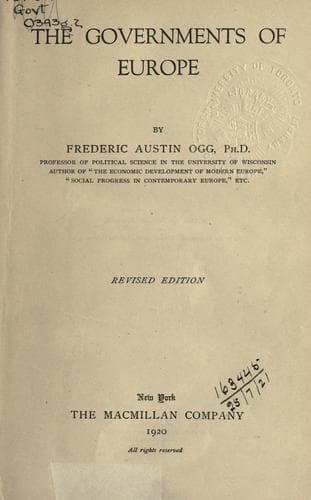
Europe -- Politics and government; Political science
*185. Periods in Local Governmental History.*--No description of a
governmental system can be adequate which does not take into account
the agencies and modes by which the powers of government are brought
close to the people, as well as those by which the people in greater
or lesser measure regulate locally their own public affairs. More
especially is this true in the instance of a government such as the
English in which local self-control is a fundamental rather than an
incidental fact. The history of local institutions in England covers
an enormous stretch of time, as well as a remarkable breadth of public
organization and activity, and by no means its least important phases
are those which have appeared in most recent times. Speaking broadly,
it may be said to fall into four very unequal periods. The first,
extending from the settlement of the Saxons to the Norman Conquest,
was marked by the establishment of the distinctive English units of
administration--shire, hundred, and township--and by the planting of
the principle of broadly popular local control. The second, extending
from the Conquest to the fourteenth century, was characterized by a
general increase of centralization and a corresponding decrease of
local autonomy. The third, extending from the fourteenth century to
the adoption of the Local Government Act of 1888, was pre-eminently a
period of aristocratic control of local affairs, of government by the
same squirearchy which prior to 1832, if not 1867, was accustomed to
dominate Parliament. The last period, that from 1888 to the present
time, has been notable in a special degree for the democratization and
systematization of local governing arrangements which has taken place
within it.
Public-domain text, read in full here on John Shaqi.
Reviews
Reviews
No reviews yet
Be the first to share your thoughts on this work.
Elsewhere in the archive
Join the Discussion
Join the discussion
Sign in to leave a comment or review.
Sign InorCreate an account