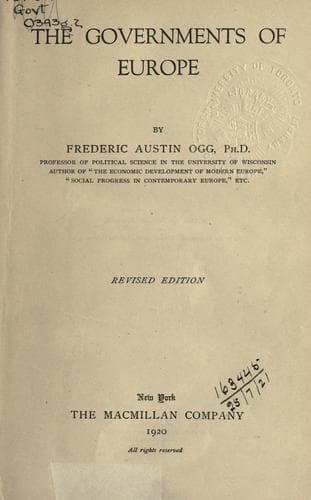
Europe -- Politics and government; Political science
*190. Local Government Act of 1888 and District and Parish (p. 180)
Councils Act of 1894.*--Soon after the passage of the Elementary
Education Act of 1870 reform began to be attempted in the direction
both of concentration of local governing authority and the
readjustment and simplification of local governing areas. In 1871 the
Poor Law Board (which succeeded the Poor Law Commission in 1847) was
converted into the Local Government Board, with the purpose of
concentrating in a single department the supervision of the laws
relating to public health, the relief of the poor, and local
government; and when, in 1872, the entire country was divided into
urban and rural sanitary districts, the work was done deliberately in
such a fashion as to involve the least possible addition to the
existing complexities of the administrative system.[258] The two
measures, however, by which, in the main, order was brought out of
confusion were the Local Government Act of 1888 and the District and
Parish Councils Act of 1894. The first of these, referred to commonly
as the County Councils Act, was the sequel of the Representation of
the People Act of 1884 and was definitely intended to invest the newly
enfranchised rural population with a larger control of county affairs.
The act created sixty-two administrative counties (some coterminous
with pre-existing counties, others comprising subdivisions of them)
and some three score "county boroughs," comprising towns of more than
50,000 inhabitants.[259] In each county and county borough there was
set up a council, at least two-thirds of whose members were elective,
and to this council was transferred the administrative functions of
the justices of the peace, leaving to those dignitaries of the old
regime little authority save of a judicial character. The
democratization of rural government accomplished by the Conservative
ministry of Lord Salisbury in 1888 was supplemented by the provisions
of the District and Parish Councils Act, carried by a Liberal ministry
in 1894.[260] This measure provided (1) that every county should be
divided into districts, urban and rural, and every district into (p. 181)
parishes, and (2) that in every district and in every rural parish
with more than three hundred inhabitants there should be an elected
council, while in the smallest parishes there should be a primary
assembly of all persons whose names appear on the local government and
parliamentary register. To the parish councils and assemblies were
transferred all of the civil functions of the vestries, leaving to
those bodies the control of ecclesiastical matters only, while to the
district councils, whether rural or urban, were committed control of
sanitary affairs and highways.
[Footnote 258: The arrangements effected at this
time were perpetuated in the great Public Health
Act of 1875. Lowell, Government of England II.,
137.]
Public-domain text, read in full here on John Shaqi.
Reviews
Reviews
No reviews yet
Be the first to share your thoughts on this work.
Elsewhere in the archive
Join the Discussion
Join the discussion
Sign in to leave a comment or review.
Sign InorCreate an account