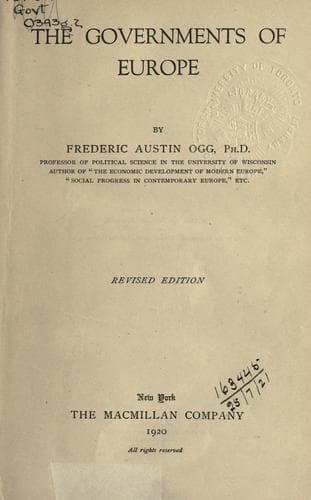
Europe -- Politics and government; Political science
*191. The Five Central Departments.*--Throughout most periods of its
history English local government has involved a smaller amount of
interference and of direction on the part of the central authorities
than have the local governments of the various continental nations.
Even to-day the general government is not present in county or borough
in any such sense as that in which the French government, in the
person of the prefect, is present in the department, or the Prussian,
through the agency of the "administration," is present in the
district. A noteworthy aspect of English administrative reform during
the past three-quarters of a century has been, nevertheless, a large
increase of centralized control, if not of technical centralization,
in relation to poor-relief, education, finance, and the other varied
functions of the local governing agencies. There are to-day five
ministerial departments which exercise in greater or lesser measure
this kind of control. One, the Home Office, has special surveillance
of police and of factory inspection. A second, the Board of Education,
directs and supervises all educational agencies which are aided by
public funds. A third, the Board of Agriculture, supervises the
enforcement of laws relating to markets and to diseases of animals. A
fourth, the Board of Trade, investigates and approves enterprises
relating to the supply of water, gas, and electricity, and to other
forms of "municipal trading." Most important of all, the Local
Government Board directs in all that pertains to the execution of the
poor laws and the activities of the local health authorities, oversees
the financial operations of the local bodies, and fulfills a variety
of other supervisory functions too extended to be enumerated. The
powers of these departments in relation to local affairs are exercised
in a number of ways, but chiefly through the promulgation of orders
and regulations, the giving or withholding of assent to proposed
measures of the local bodies, and the giving of expert advice and
guidance. It need hardly be added that the powers and functions of the
local authorities are subject at all times to control by parliamentary
legislation.[262]
[Footnote 262: On the relations between the central
and local agencies of government see Lowell,
Government of England, II., Chap. 46; J. Redlich
and F. W. Hirst, Local Government in England, 2
vols. (London, 1903), II., Pt. 6; Traill, Central
Government, Chap. 11; and M. R. Maltbie, English
Local Government of To-day; a Study of the
Relations of Central and Local Government (New
York, 1897).]
VII. LOCAL GOVERNMENT TO-DAY: RURAL (p. 183)
Public-domain text, read in full here on John Shaqi.
Reviews
Reviews
No reviews yet
Be the first to share your thoughts on this work.
Elsewhere in the archive
Join the Discussion
Join the discussion
Sign in to leave a comment or review.
Sign InorCreate an account