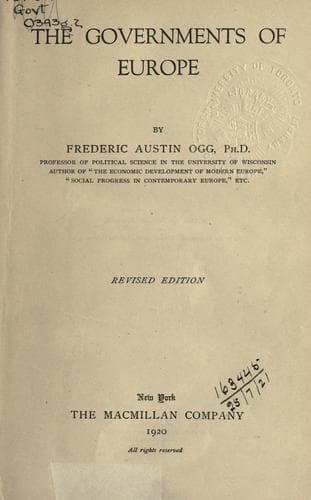
Europe -- Politics and government; Political science
*195. The Parish.*--Of parishes there are two types, the rural and the
urban, and their aggregate number in England and Wales is
approximately 15,000. The urban parishes possess no general
administrative importance and further mention need not be made of them
here. Under the act of 1894 the rural parish, however, has been
revived in a measure from the inert condition into which it had
fallen, and it to-day fills an appreciable if humble place in the
rural administrative regime. The style of its organization is
dependent to a degree upon its population. In each parish there is a
meeting in which all persons on the local government and parliamentary
registers (including women and lodgers) are privileged to participate.
This meeting elects its own chairman, and it likewise chooses a number
of overseers whose duty it is to assess and collect certain local
rates, to administer the poor-rate, and to make up the electoral and
jury lists. All parishes whose population numbers as much as three
hundred have a council composed of from five to fifteen members (women
being eligible), elected as a rule for a term of three years. The list
of powers which the parish authorities may exercise is extended, if
not imposing. It includes the maintenance of foot-paths, the
management of civil parochial property, the provision of fire
protection, the inspection of local sanitation, and the appointment of
trustees of civil charities within the parish. The meagerness of the
population of large numbers of the parishes, however, together with
the severe limitations imposed both by law and by practical conditions
upon rate-levying powers, preclude the authorities very generally (p. 186)
from undertaking many or large projects. It is regarded commonly that
the parishes are too small to be made such areas of public activity as
the authors of the act of 1894 had in mind. Practically, the parish is
little more than a unit for the election of representatives and the
collection of rates.[267]
[Footnote 267: Lowell, Government of England, II.,
281.]
For purposes of poor-law administration, as has been pointed out,
there have existed since 1834 poor-law unions, consisting of numbers
of parishes grouped together, usually without much effort to obtain
equality of size or population. These unions not infrequently comprise
both rural and urban parishes, and in cases of this kind the board of
guardians is composed of the persons elected as district councillors
in the rural parishes of the union, together with other persons who
are elected immediately as guardians in the urban parishes and have no
other function. The conditions under which poor relief is administered
are prescribed rather minutely in general regulations laid down by the
Local Government Board at London, so that, save in the matter of
levying rates, the range of discretion left to the boards of guardians
is closely restricted.[268]
Public-domain text, read in full here on John Shaqi.
Reviews
Reviews
No reviews yet
Be the first to share your thoughts on this work.
Elsewhere in the archive
Join the Discussion
Join the discussion
Sign in to leave a comment or review.
Sign InorCreate an account