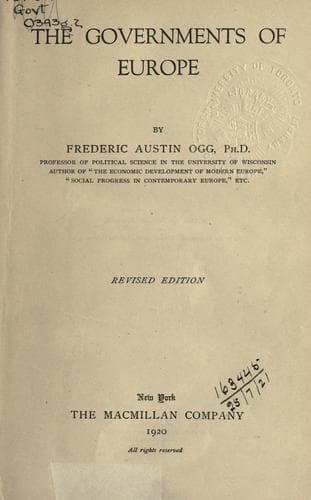
Europe -- Politics and government; Political science
[Footnote 276: On Germany during the Napoleonic
period see Cambridge Modern History, IX., Chap. 11;
J. H. Rose, Life of Napoleon I., 2 vols. (new ed.,
New York, 1910), II., Chaps. 24-25; A. Fournier,
Napoleon I., a Biography, trans, by A. E. Adams, 2
vols, (New York, 1911), I., Chaps. 11-12; J. R.
Seeley, Life and Times of Stein; or Germany and
Prussia in the Napoleonic Age, 3 vols. (Cambridge,
1878); H. A. L. Fisher, Studies in Napoleonic
Statesmanship, Germany (Oxford, 1903).]
*203. The Congress of Vienna and the Confederation of 1815.*--The
collapse of the dominion of Napoleon was followed in Germany by rather
less of a return to earlier arrangements than might have been
expected. Indeed, it can hardly be said to have involved any such
return at all. The Confederation of the Rhine was dissolved, and both
the grand-duchy of Warsaw and the kingdom of Westphalia ceased, as
such, to be. But the Holy Roman Empire was not revived; the newly
acquired dignities of the sovereigns of Saxony, Bavaria, and other
states were perpetuated; despite the clamors of the mediatized
princes, the scores of German states which during the decade had been
swallowed up by their more powerful neighbors, or had been otherwise
blotted out, were not re-established; and--most important of all--the
social and economic changes by which the period had been given (p. 195)
distinction were, in large part, not undone.
Public-domain text, read in full here on John Shaqi.
Reviews
Reviews
No reviews yet
Be the first to share your thoughts on this work.
Elsewhere in the archive
Join the Discussion
Join the discussion
Sign in to leave a comment or review.
Sign InorCreate an account