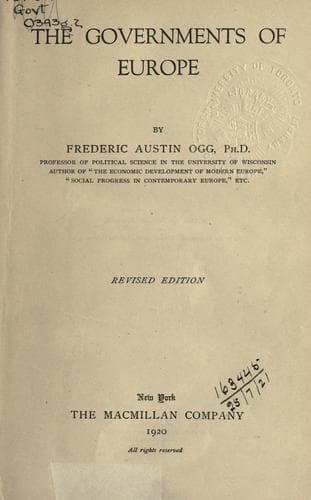
Europe -- Politics and government; Political science
*213. Federal Character of the Empire.*--The political system of Germany
to-day is the product of centuries of particularistic statecraft,
capped, in 1871, by a partial centralization of sovereign organs and
powers. The Empire is composed of twenty-five states: the four kingdoms
of Prussia, Bavaria, Saxony, and Wuerttemberg; the six grand-duchies of
Baden, Hesse, Mecklenburg-Schwerin, Saxe-Weimar, Mecklenburg-Strelitz,
and Oldenburg; the five duchies of Brunswick, Saxe-Meiningen,
Saxe-Altenburg, Saxe-Coburg-Gotha, and Anhalt; the seven (p. 204)
principalities of Schwarzburg-Sonderhausen, Schwarzburg-Rudolstadt,
Waldeck, Reuss Aelterer Linie, Reuss Juengerer Linie, Lippe, and
Schaumburg-Lippe; and the three free cities of Hamburg, Bremen, and
Luebeck. These states vary in size from Prussia, with 134,616 square
miles, to Bremen, with 99; and in population, from Prussia, with
40,163,333, to Schaumburg-Lippe, with 46,650. There is, in addition,
the _Reichsland_, or Imperial domain, of Alsace-Lorraine, whose status
until 1911 was that of a purely dependent territory, but which by act
of the year mentioned was elevated to a condition of quasi-statehood.[284]
[Footnote 284: See p. 285.]
Prior to the formation in 1867, of the North German Confederation,
each of the twenty-five states was sovereign and essentially
independent. Each had its own governmental establishment, and in many
instances the existing political system was of considerable antiquity.
With the organization of the _Bund_, those states which were
identified with the federation yielded their independence, and
presumably their sovereignty; and with the establishment of the
Empire, all gave up whatever claim they as yet maintained to absolute
autonomy. Both the _Bund_ and the Empire were creations, strictly
speaking, of the states, not of the people; and, to this day, as one
writer has put it, the Empire is "not a juristic person composed of
fifty-six million members, but of twenty-five members."[285] At the
same time, it is not what the old Confederation of 1815 was, i.e., a
league of princes. It is a state established by, and composed of,
states.[286]
[Footnote 285: P. Laband, Das Staatsrecht des
deutschen Reiches, I., 91.]
Public-domain text, read in full here on John Shaqi.
Reviews
Reviews
No reviews yet
Be the first to share your thoughts on this work.
Elsewhere in the archive
Join the Discussion
Join the discussion
Sign in to leave a comment or review.
Sign InorCreate an account