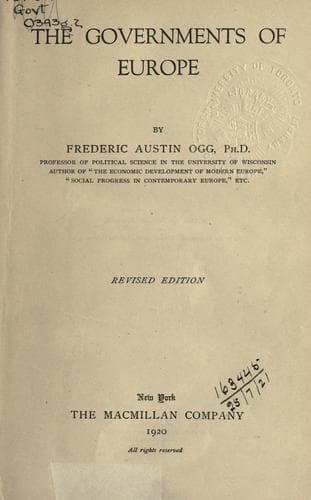
Europe -- Politics and government; Political science
*220. Status and Privileges.*--Under the North German Confederation of
1867-1871 the king of Prussia was vested with supreme command of the
federal navy, the functions of Bundesfeldherr, or commander-in-chief
of the federal army, and a large group of purely governmental powers,
including the summoning, proroguing, and adjourning of the Bundesrath
and Bundestag, the appointment and dismissal of the Chancellor and of
other federal officials, the publication of the federal laws, and a
general supervision of the federal administration. These powers were
exercised by the king in the capacity of _Bundespraesidium_, or chief
magistrate, of the federation. Upon the accession of the south German
states in 1870-1871 Bismarck and his royal master determined to bring
once more into use in Germany the title of Emperor, although between
the empire which was now assuming form and the empire which had been
terminated in 1806 there was recognized to be no historical
connection. The constitution of April 16, 1871, accordingly stipulates
that "to the king of Prussia shall belong the presidency of the
Confederation, and he shall bear the title of _Deutscher Kaiser_
(German Emperor)."[298]
[Footnote 298: Art. II. Dodd, Modern Constitutions,
I., 330. It will be observed that the title is not
"Emperor of Germany." The phrase selected was
intended to denote that the Emperor is only _primus
inter pares_ in a confederation of territorial
sovereigns (_Landesherren_.) He is a territorial
sovereign only in Prussia.]
Public-domain text, read in full here on John Shaqi.
Reviews
Reviews
No reviews yet
Be the first to share your thoughts on this work.
Elsewhere in the archive
Join the Discussion
Join the discussion
Sign in to leave a comment or review.
Sign InorCreate an account