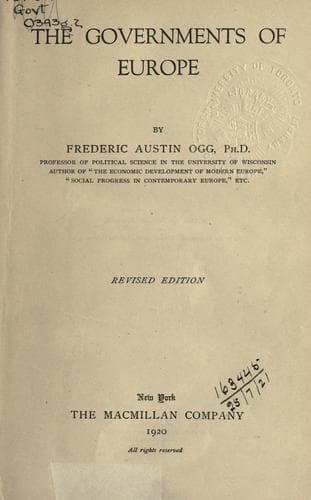
Europe -- Politics and government; Political science
The functions of the Emperor as such are not numerous, but, so far as
they go, they are of fundamental importance. In the first place, the
Emperor is commander-in-chief of the army and navy. He may control the
organization of the Landwehr, or national defense; determine the
strength and composition of the armed contingents; supervise the
equipment and drilling of the troops; and mobilize the whole, or any
part, of the forces.[301] A second group of Imperial functions are
those relating to foreign affairs. "It shall be the duty of the
Emperor," says the constitution, "to represent the Empire among
nations, to declare war and to conclude peace in the name of the
Empire, to enter into alliances and other treaties with foreign
countries, to accredit ambassadors and to receive them."[302] The (p. 212)
Emperor's power, however, is not in all of these directions absolute.
One important limitation arises from the requirement that, under all
circumstances save in the event of an attack upon the federal
territory or its coasts, war may be declared only with the consent of
the Bundesrath. Another is that in so far as treaties with foreign
countries relate to matters which are to be regulated by Imperial
legislation, "the consent of the Bundesrath shall be required for
their conclusion, and the approval of the Reichstag shall be necessary
to render them valid."[303]
[Footnote 301: Howard, The German Empire, Chap. 12;
Laband, Deutsches Reichsstaatsrecht, 345-359.]
[Footnote 302: Art. II. Dodd, Modern Constitutions,
I., 330.]
[Footnote 303: Art. II, clause 3. Dodd, I., 331.]
*222. Powers: Legislation and Justice.*--A third group of functions has
to do with legislation. By the constitution the Emperor is vested with
the right to convene the Bundesrath and the Reichstag, and to open,
adjourn, and close them.[304] In accordance with resolutions of the
Bundesrath, bills are laid before the Reichstag in the name of the
Emperor; and it is the Emperor's duty to prepare and publish the laws
of the Empire, as well as to supervise their execution.[305] In so far
as is permitted by the constitution, and by laws from time to time
enacted, decrees and ordinances may be promulgated by the Emperor,
under the countersignature of the Chancellor. Speaking strictly, the
Emperor possesses no veto upon measures passed in the Bundesrath and
Reichstag, though in practice he may refuse to publish a law in the
enactment of which he believes the ordinary formal requirements not to
have been complied with. He may not withhold a measure by reason
simply of its content.
[Footnote 304: Art. 12. Ibid.]
Public-domain text, read in full here on John Shaqi.
Reviews
Reviews
No reviews yet
Be the first to share your thoughts on this work.
Elsewhere in the archive
Join the Discussion
Join the discussion
Sign in to leave a comment or review.
Sign InorCreate an account