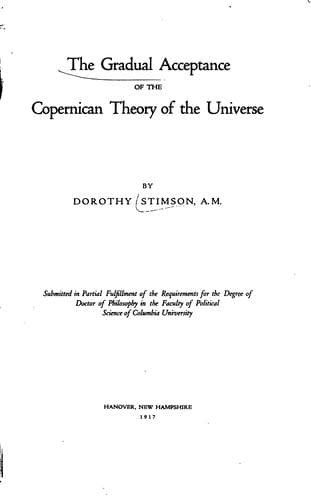
The gradual acceptance of the Copernican theory of the universeStimson, Dorothy
History
The gradual acceptance of the Copernican theory of the universe
Stimson, Dorothy
Astronomy -- History; Copernicus, Nicolaus, 1473-1543; Solar system
Even more hotly debated has been the action of the Congregations in
condemning the Copernican doctrine, and sentencing Galileo as a
heretic for upholding it.[291] Though both Paul V and Urban VIII
spurred on these actions, neither signed either the decree or the
sentence, nor was the latter present at Galileo's examinations. Pope
Urban would prefer not so openly to have changed his position from
that of tolerance to his present one of active opposition caused
partly by his piqued self-respect[292] and partly by his belief that
this heresy was more dangerous even than that of Luther and
Calvin.[293] It is a much mooted question whether the infallibility of
the Church was involved or not. Though the issue at stake was not one
of faith, nor were the decrees issued by the Pope _ex cathedra_, but
by a group of Cardinals, a fallible body, yet they had the full
approbation of the Popes, and later were published in the Index
preceded by a papal bull excommunicating those who did not obey the
decrees contained therein.[294] It seems to be a matter of the letter
as opposed to the spirit of the law. De Morgan points out that
contemporary opinion as represented by Fromundus, an ardent opponent
of Galileo, did not consider the Decree of the Index or of the
Inquisition as a declaration of the Church,[295]--a position which
Galileo himself may have held, thus explaining his practical disregard
of the decree of 1616 after he was persuaded the authorities were more
favorably disposed to him. But M. Martin, himself a Catholic,
thinks[296] that theoretically the Congregations could punish Galileo
only for disobedience of the secret order,--but even so his book had
been examined and passed by the official censors.
[Footnote 291: See Gebler: 244-247; White: I, 159-167; also Martin.]
[Footnote 292: Martin: 136; and Salusbury: _Math. Coll._ "To the
reader."]
[Footnote 293: Galileo: _Opere_, XV, 25.]
[Footnote 294: Putnam: I, 310.]
[Footnote 295: De Morgan: I, 98.]
[Footnote 296: Martin: 140.]
Public-domain text, read in full here on John Shaqi.
Reviews
Reviews
No reviews yet
Be the first to share your thoughts on this work.
Join the Discussion
Join the discussion
Sign in to leave a comment or review.
Sign InorCreate an account