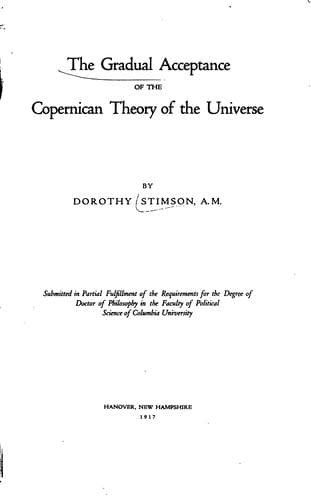
The gradual acceptance of the Copernican theory of the universeStimson, Dorothy
History
The gradual acceptance of the Copernican theory of the universe
Stimson, Dorothy
Astronomy -- History; Copernicus, Nicolaus, 1473-1543; Solar system
When the Index was revised under Pope Benedict XIV in 1757, largely
through the influence of the Jesuit astronomer Boscovich, so it is
said,[297] the phrase prohibiting all books teaching the immobility
of the sun, and the mobility of the earth was omitted from the
decrees.[298] But in 1820, the Master of the Sacred Palace refused to
permit the publication in Rome of a textbook on astronomy by Canon
Settele, who thereupon appealed to the Congregations. They granted his
request in August, and two years later, issued a decree approved by
Pope Pius VII ordering the Master of the Sacred Palace in future "not
to refuse license for publication of books dealing with the mobility
of the earth and the immobility of the sun according to the common
opinion of modern astronomers" on that ground alone.[299] The next
edition of the _Index Librorum Prohibitorum_ (1835) did not contain
the works of Copernicus, Galileo, Foscarini, à Stunica and Kepler
which had appeared in every edition up to that time since their
condemnation in 1616, (Kepler's in 1619).
[Footnote 297: _Cath. Ency._: "Boscovich."]
[Footnote 298: Doc. in Favaro: 159.]
[Footnote 299: Ibid: 30, 31.]
CHAPTER III.
THE OPPOSITION AND THEIR ARGUMENTS.
The Protestant leaders had rejected the Copernican doctrine as
contrary to the Scriptures. The Roman Congregations had now condemned
Galileo for upholding this doctrine after they had prohibited it for
the same reasons. These objections are perhaps best summarized in that
open letter Foscarini wrote to the general of his order, the
Carmelites, at Naples in January, 1615,[300]--the letter that was
absolutely prohibited by the Index in March, 1616. He gave these
arguments and answered them lest, as he said, "whilst otherwise the
opinion is favored with much probability, it be found in reality to be
extremely repugnant (as at first sight it seems) not only to physical
reasons and common principles received on all hands (which cannot do
so much harm), but also (which would be of far worse consequence) to
many authorities of Sacred Scripture. Upon which account many at first
looking into it explode it as the most fond paradox and monstrous
_capriccio_ that ever was heard of." "Yet many modern authors," he
says further on, "are induced to follow it, but with much hesitancy
and fear, in regard that it seemeth in their opinion so to contradict
the Holy Scriptures that it cannot possibly be reconciled to them."
Consequently Foscarini argued that the theory is either true or false;
if false, it ought not to be divulged; if true, the authority of the
Sacred Scriptures will not oppose it; neither does one truth
contradict another. So he turned to the Bible.
[Footnote 300: In Salusbury: _Math. Coll._: I, 471-503.]
Public-domain text, read in full here on John Shaqi.
Reviews
Reviews
No reviews yet
Be the first to share your thoughts on this work.
Join the Discussion
Join the discussion
Sign in to leave a comment or review.
Sign InorCreate an account