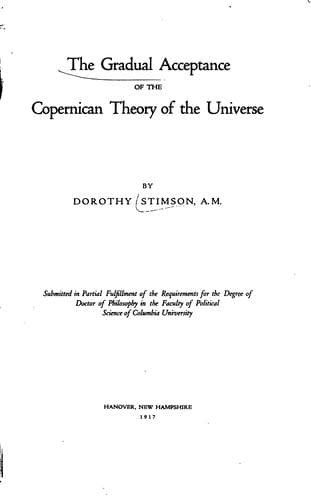
The gradual acceptance of the Copernican theory of the universeStimson, Dorothy
History
The gradual acceptance of the Copernican theory of the universe
Stimson, Dorothy
Astronomy -- History; Copernicus, Nicolaus, 1473-1543; Solar system
Some or all of these scriptural arguments appear in most of the
attacks on the doctrine even before its condemnation by the Index in
1616 was widely known. Besides these objections, Aristotle's and
Ptolemy's statements were endlessly repeated with implicit faith in
their accuracy. Even Sir Francis Bacon (1567-1631) with all his
modernity of thought, failed in this instance to recognize the value
of the new idea and, despite his interest in Galileo's discoveries,
harked back to the time-honored objections. At first mild in his
opposition, he later became emphatically opposed to it. In the
_Advancement of Learning_[301] (1604), he speaks of it as a possible
explanation of the celestial phenomena according to astronomy but as
contrary to natural philosophy. Some fifteen years later in the _Novum
Organon_,[302] he asserts that the assumption of the earth's movement
cannot be allowed; for, as he says in his _Thema Coeli_,[303] at
that time he considered the opinion that the earth is stationary the
truer one. Finally, in his _De Augmentis Scientiarum_[304] (1622-1623)
he speaks of the old notions of the solidity of the heavens, etc., and
adds, "It is the absurdity of these opinions that has driven men to
the diurnal motion; which I am convinced is most false." He gives his
reasons in the _Descriptio Globi Intellectualis_[305] (ch. 5-6): "In
favor of the earth [as the center of the world] we have the evidence
of our sight, and an inveterate opinion; and most of all this, that as
dense bodies are contracted into a narrow compass, and rare bodies are
widely diffused (and the area of every circle is contracted to the
center) it seems to follow almost of necessity that the narrow space
about the middle of the world be set down as the proper and peculiar
place for dense bodies." The sun's claims to such a situation are
satisfied through having two satellites of its own, Venus and Mercury.
Copernicus's scheme is inconvenient; it overloads the earth with a
triple motion; it creates a difficulty by separating the sun from the
number of the planets with which it has much in common; and the
"introduction of so much immobility into nature ... and making the
moon revolve around the earth in an epicycle, and some other
assumptions of his are the speculations of one who cares not what
fictions he introduces into nature, provided his calculations answer."
The total absence of all reference to the Scriptures is the unique and
refreshing part of Bacon's thought.
[Footnote 301: Bk. II: sec. 8, §1.]
[Footnote 302: Bk. II, ch. 46.]
[Footnote 303: _Phil. Works_: 705.]
[Footnote 304: Bk. III.]
[Footnote 305: _Phil. Works_: 684-685.]
Public-domain text, read in full here on John Shaqi.
Reviews
Reviews
No reviews yet
Be the first to share your thoughts on this work.
Join the Discussion
Join the discussion
Sign in to leave a comment or review.
Sign InorCreate an account