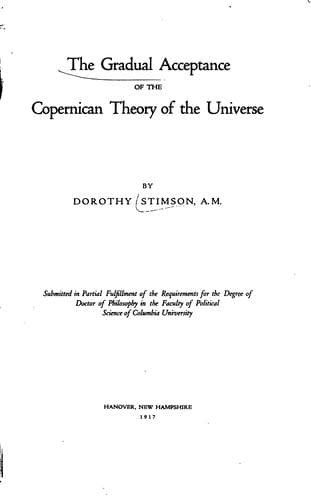
The gradual acceptance of the Copernican theory of the universeStimson, Dorothy
History
The gradual acceptance of the Copernican theory of the universe
Stimson, Dorothy
Astronomy -- History; Copernicus, Nicolaus, 1473-1543; Solar system
All the more common arguments against the diurnal rotation of the
earth are well stated in an interesting little letter (1619) by
Thomas Feyens, or Fienus, a professor at the school of medicine in the
University of Louvain.[306] Thus Catholic, Protestant, and unbeliever,
Feyens, Melancthon, Bacon and Bodin, all had recourse to the same
arguments to oppose this seemingly absurd doctrine.
[Footnote 306: Translated in Appendix C. For criticism, see Monchamp:
58-64.]
Froidmont, or Fromundus, the good friend and colleague of Feyens at
Louvain, was also much interested in these matters, so much so that
some thought he had formerly accepted the Copernican doctrine and
"only fled back into the camp of Aristotle and Ptolemy through terror
at the decree of the S. Congregation of Cardinals."[307] His indignant
denial of this imputation of turn-coat in 1634 is somewhat weakened by
reference to his _Saturnalitæ Coenæ_[308] (1615) in which he suggests
that, if the Copernican doctrine is admitted, then Hell may be in the
sun at the center of the universe rather than in the earth, in order
to be as far as possible from Paradise. He also refers in his _De
Cometa_ (1618) to the remark of Justus-Lipsius[309] that this paradox
was buried with Copernicus, saying "You are mistaken, O noble scholar:
it lives, and it is full of vigor even now among many,"[310] thus
apparently not seeing serious objection to it. M. Monchamp summarizes
Froidmont's point of view as against Aristotle and Ptolemy, half for
Copernicus and wholly for Tycho Brahe.
[Footnote 307: Fromundus: _Vesta_: Ad Lectorem.]
[Footnote 308: Monchamp: 41.]
[Footnote 309: Justus-Lipsius: IV, 947.]
[Footnote 310: Monchamp: 48.]
Public-domain text, read in full here on John Shaqi.
Reviews
Reviews
No reviews yet
Be the first to share your thoughts on this work.
Elsewhere in the archive
Join the Discussion
Join the discussion
Sign in to leave a comment or review.
Sign InorCreate an account