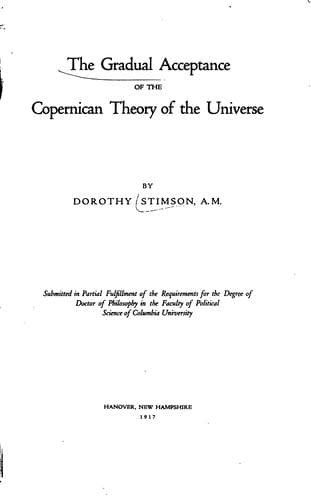
The gradual acceptance of the Copernican theory of the universeStimson, Dorothy
History
The gradual acceptance of the Copernican theory of the universe
Stimson, Dorothy
Astronomy -- History; Copernicus, Nicolaus, 1473-1543; Solar system
Copernicus
Rheticus
Mæstlin
Kepler
Rothman
Galileo
Gilbert (diurnal motion)
Foscarini
Didacus Stunica (_sic_)
Ismael Bullialdus
Jacob Lansberg
Peter Herigonus
Gassendi,--"but submits his intellect captive to the Church decrees."
Descartes "inclines to this belief."
A.L. Politianus
Bruno
Against the hypothesis of the earth's movement.
Aristotle
Ptolemy
Theon the Alexandrine
Regiomontanus
Alfraganus
Macrobius
Cleomedes
Petrus Aliacensis
George Buchanan
Maurolycus
Clavius
Barocius
Michael Neander
Telesius
Martinengus
Justus-Lipsius
Scheiner
Tycho
Tasso
Scipio Claramontius
Michael Incofer
Fromundus
Jacob Ascarisius
Julius Cæsar La Galla
Tanner
Bartholomæus Amicus
Antonio Rocce
Marinus Mersennius
Polacco
Kircher
Spinella
Pineda
Lorinis
Mastrius
Bellutris
Poncius
Delphinus
Elephantutius
[Footnote 340: Riccioli: _Alm. Nov._: II, 290.]
Riccioli nevertheless viewed the Copernican system with much sympathy.
After a full statement of it, he comments: "We have not yet exhausted
the full profundities of the Copernican hypothesis, for the deeper one
digs into it, the more ingenious and valuable subtilties may one
unearth." Then he adds that "the greatness of Copernicus has never
been sufficiently appreciated nor will it be,--that man who
accomplished what no astronomer before him had scarcely been able even
to suggest without an insane machinery of spheres, for by a triple
motion of the earth he abolished epicycles and eccentrics. What before
so many Atlases could not support, this one Hercules has dared to
carry. Would that he had kept himself within the limits of his
hypothesis!"[341]
[Footnote 341: Riccioli: _Op. cit._: II, 304, 309.]
His conclusions seem to show that only his position as a Jesuit
restrained him from being a Copernican himself.[342] "I. If the
celestial phenomena alone are considered, they are equally well
explained by the two hypotheses [Ptolemaic and Copernican]. II. The
physical evidence as explained in the two systems with exception of
percussion and the speed of bodies driven north or south, and east or
west, is all for immobility. III. One might waver indifferently
between the two hypotheses aside from the witness of the Scriptures,
which settles the question. IV. There are in addition plenty of other
motives besides Scriptural ones for rejecting this system." (!) But
with the Scriptural evidence he adduces the decree of the Index under
Paul V against the doctrine, and the sentence of Galileo, so that "the
sole possible conclusion is that the earth stands by nature immobile
in the center of the universe, and the sun moves around it with both a
diurnal and an annual motion."[343]
[Footnote 342: Delambre: _Astr. Mod._: I, 680.]
[Footnote 343: Riccioli: _Op. cit._: II, 478 (condensed), 500.]
Public-domain text, read in full here on John Shaqi.
Reviews
Reviews
No reviews yet
Be the first to share your thoughts on this work.
Elsewhere in the archive
Join the Discussion
Join the discussion
Sign in to leave a comment or review.
Sign InorCreate an account