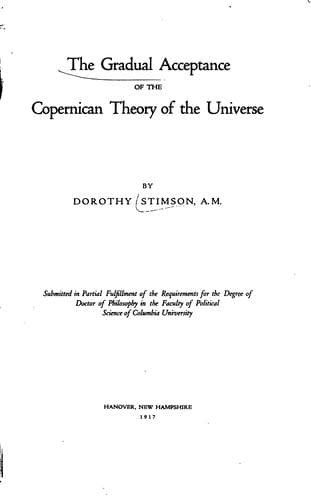
The gradual acceptance of the Copernican theory of the universeStimson, Dorothy
History
The gradual acceptance of the Copernican theory of the universe
Stimson, Dorothy
Astronomy -- History; Copernicus, Nicolaus, 1473-1543; Solar system
Saturn and Jupiter are the greatest planets and with the sphere of the
fixed stars move more slowly; (4) Mars belongs with the sun because of
their related movements; and (5) because it is likely that one of the
planets would have much in common both with Saturn and Jupiter and
with Mercury and Venus also.[332]
[Footnote 330: _Cath. Ency._: "Riccioli," and Walsh: Catholic
Churchmen in Science: 200. (2nd series, 1909.)]
[Footnote 331: Riccioli: _Alm. Nov._: II, 288-289; see frontispiece.]
[Footnote 332: Riccioli: _Alm. Nov._: II, 288-289; see frontispiece.]
Then he takes up the attack upon the Copernican doctrine. M. Delambre
summarizes and comments upon 57 of his arguments against it,[333] and
Riccioli himself claims[334] to have stated "40 new arguments in
behalf of Copernicus and 77 against him." But these sound somewhat
familiar to the reader of anti-Copernican literature: as, for
instance, "which is more natural, straight or circular movement?" Or,
the Copernican argument that movement is easier if the object moved is
smaller involves a matter of Faith since it implies a question of
God's power; for to God all is alike, there is no hard nor easy.[335]
Although diurnal movement is useful to the earth alone and so,
according to the Copernicans, the earth should have the labor of it,
Riccioli argues that everything was created for man; let the stars
revolve around him. The sun may be nobler than the earth, but man is
nobler than the sun.[336] If the earth's movement were admitted,
Ptolemy's defense would be broken down through the elimination of the
epicycles of the superior planets: here, if ever, the Copernicans
appear to score, as Riccioli himself admits,[337] but he calls to his
aid Tycho Brahe and the Bible. "To invoke such aids is to avow his
defeat" is M. Delambre's comment at this point.[338] There are many
more arguments, of which the foregoing are but instances chosen more
or less at random; but no one of them is of especial weight or
novelty.
[Footnote 333: Delambre: _Astr. Mod._: I, 674-680.]
[Footnote 334: Riccioli: _Apologia_: 2.]
[Footnote 335: Riccioli: _Alm. Nov._: II, 313, 315.]
[Footnote 336: Riccioli: _Alm. Nov._: II, 330-351.]
[Footnote 337: Ibid: II, 339-340.]
[Footnote 338: Delambre: _Op. cit._: I, 677.]
To strengthen his case, Riccioli listed the supporters of the
heliocentric doctrine throughout the ages, with those of the opposite
view. If a man's fame adds to the weight of his opinion, the modern
reader will be inclined to think the Copernicans have the best of it,
for omitting the ancients, most of those opposing it are obscure
men.[339]
[Footnote 339: Ibid: I, 673.]
In favor of the Copernican doctrine [references omitted].[340]
Public-domain text, read in full here on John Shaqi.
Reviews
Reviews
No reviews yet
Be the first to share your thoughts on this work.
Elsewhere in the archive
Join the Discussion
Join the discussion
Sign in to leave a comment or review.
Sign InorCreate an account