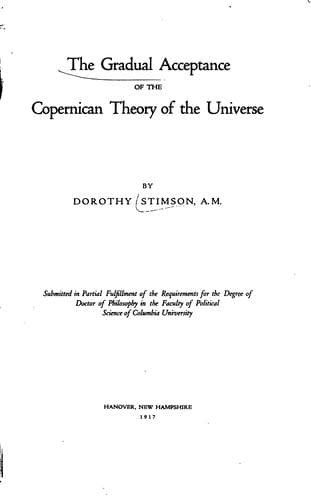
The gradual acceptance of the Copernican theory of the universeStimson, Dorothy
History
The gradual acceptance of the Copernican theory of the universe
Stimson, Dorothy
Astronomy -- History; Copernicus, Nicolaus, 1473-1543; Solar system
One present-day Catholic calls the action of the Congregations "a
theoretical mistake;"[418] another admits it was a deplorable mistake,
but practically their only serious one;[419] and a third considers it
"providential" since it proved conclusively "that whenever there is
apparent contradiction between the truths of science and the truths of
faith, either the scientist is declaring as proved what in reality is
a mere hypothesis, or the theologian is putting forth his own personal
views instead of the teaching of the Gospel."[420] Few would accept
today, however, the opinion of the anonymous writer in the _Dublin
Review_ in the forties that "to the Pontiffs and dignitaries of Rome
we are mainly indebted for the Copernican system" and that the phrases
"heretical" and "heresy" in the sentence of 1633 were but the _stylus
curiæ_, for it was termed heresy only in the technical sense.[421]
[Footnote 418: Donat: 183.]
[Footnote 419: Walsh: _Popes and Science_, 17.]
[Footnote 420: Conway: 48.]
[Footnote 421: Anon.: _Galileo--the Roman Congregation_, 39, 60.]
The majority of Protestants, with the possible exception of the
Lutherans, were satisfied with the probable truth of the Copernican
doctrine before the end of the 18th century. Down to the present day,
however, there have been isolated protests raised against it, usually
on technical grounds supported by reference to the Scriptures. De
Morgan refers to one such, "An Inquiry into the Copernican System ...
wherein it is proved in the clearest manner, that the earth has only
her diurnal motion ... with an attempt to point out the only true way
whereby mankind can receive any real benefit from the study of the
heavenly bodies, by John Cunningham, London, 1789." De Morgan adds
that "the true way appears to be the treatment of heaven and earth as
emblematical of the Trinity."[422] Another, by "Anglo-American," is
entitled "Copernicus Refuted; or the True Solar System" (Baltimore,
1846). It begins thus:
"One of these must go, the other stand still,
It matters not which, so choose at your will;
But when you find one already stuck fast,
You've only got Hobson's choice left at last."
[Footnote 422: De Morgan: I, 172.]
Public-domain text, read in full here on John Shaqi.
Reviews
Reviews
No reviews yet
Be the first to share your thoughts on this work.
Elsewhere in the archive
Join the Discussion
Join the discussion
Sign in to leave a comment or review.
Sign InorCreate an account