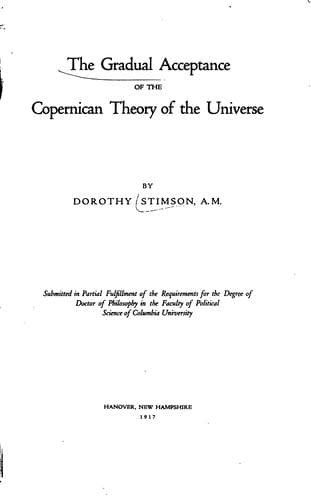
The gradual acceptance of the Copernican theory of the universeStimson, Dorothy
History
The gradual acceptance of the Copernican theory of the universe
Stimson, Dorothy
Astronomy -- History; Copernicus, Nicolaus, 1473-1543; Solar system
Such statements are futile in themselves nowadays, and are valuable
only to illustrate the advance of modern thought of which these are
the little eddies. While modern astronomers know far more than
Copernicus even dreamed of, much of his work still holds true today.
The world was slow to accept his system because of tradition,
authority, so-called common sense, and its supposed incompatibility
with scriptural passages. Catholic and Protestant alike opposed it on
these grounds; but because of its organization and authority, the
Roman Catholic Church had far greater power and could more
successfully hinder and delay its acceptance than could the
Protestants. Consequently the system won favor slowly at first through
the indifference of the authorities, then later in spite of their
active antagonism. Scholars believed it long before the universities
were permitted to teach it; and the rationalist movement of the 18th
century, the revolt against a superstitious religion, helped to
overturn the age-old conception of the heavens and to bring
Newtonian-Copernicanism into general acceptance.
The elements of this traditional conception are summarized in the
fifth book of Bodin's _Universæ Naturæ Theatrum_, a scholar's account
of astronomy at the close of the sixteenth century.[436] Man in his
terrestrial habitation occupies the center of a universe created
solely to serve him, God presides over all from the Empyrean above,
sending forth his messengers the angels to guide and control the
heavenly bodies. Such had been the thought of Christians for more than
a thousand years. Then came the influence of a new science. Tycho
Brahe "broke the crystal spheres of Aristotle"[437] by his study of
the comet of 1572; Galileo's telescopes revealed many stars hitherto
unknown, and partly solved the mysteries of the Milky Way; Kepler's
laws explained the courses of the planets, and Newton's discovery of
the universal application of the forces of attraction relieved the
angels of their duties among the heavens. Thinkers like Bruno proposed
the possibility of other systems and universes besides the solar one
in which the earth belongs. And thus not only did man shrink in
importance in his own eyes; but his conception of the heavens changed
from that of a finite place inexplicably controlled by the mystical
beings of a supernatural world, to one of vast and infinite spaces
traversed by bodies whose density and mass a man could calculate,
whose movements he could foretell, and whose very substance he could
analyze by the science of today. This dissolution of superstition,
especially in regard to comets was notably rapid and complete after
the comet of 1680.[438] Thus the rationalist movement with the new
science opened men's minds to a universe composed of familiar
substances and controlled by known or knowable laws with no tinge
remaining of the supernatural. Today a man's theological beliefs are
not shaken by the discovery of a new satellite or even a new planet,
Public-domain text, read in full here on John Shaqi.
Reviews
Reviews
No reviews yet
Be the first to share your thoughts on this work.
Elsewhere in the archive
Join the Discussion
Join the discussion
Sign in to leave a comment or review.
Sign InorCreate an account