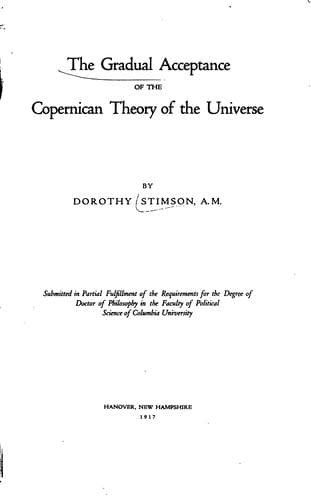
The gradual acceptance of the Copernican theory of the universeStimson, Dorothy
History
The gradual acceptance of the Copernican theory of the universe
Stimson, Dorothy
Astronomy -- History; Copernicus, Nicolaus, 1473-1543; Solar system
in comparison to the bodies falling on it, could receive these in
their fall without acquiring the slightest motion from the shock of
their weight or of their velocity. But if the earth had a movement
which was common to it and to all other heavy bodies, it would soon
seemingly outstrip them as a result of its weight, thus leaving the
animals and the other heavy bodies without other support than the air,
and would soon touch the limits of the heaven itself. All these
consequences would seem most ridiculous if one were only even
imagining them.
There are those who, while they admit these arguments because there is
nothing to oppose them, pretend that nothing prevents the supposition,
for instance, that if the sky is motionless, the earth might turn on
its axis from west to east, making this revolution once a day or in a
very little less time, or that, if they both turn, it is around the
same axis, as we have said, and in a manner conformable to the
relations between them which we have observed.
It has escaped these people that in regard to the appearances of the
planets themselves, nothing perhaps prevents the earth from having the
simpler motion; but they do not realize how very ridiculous their
opinion is in view of what takes place around us and in the air. For
if we grant them that the lightest things and those composed of the
subtlest parts do not move, which would be contrary to nature, while
those that are in the air move visibly more swiftly than those that
are terrestrial; if we grant them that the most solid and heavy bodies
have a swift, steady movement of their own, though it is true however
that they obey impelling forces only with difficulty; they would be
obliged to admit that the earth by its revolution has a movement more
rapid than the movements taking place around it, since it would make
so great a circuit in so short a time. Thus the bodies which do not
rest on it would appear always to have a motion contrary to its own,
and neither the clouds, nor any missile or flying bird would appear to
go towards the east, for the earth would always outstrip them in this
direction, and would anticipate them by its own movement towards the
east, with the result that all the rest would appear to move backwards
towards the west.
If they should say that the atmosphere is carried along by the earth
with the same speed as the earth's own revolution, it would be no less
true that the bodies contained therein would not have the same
velocity. Or if they were swept along with the air, no longer would
anything seem to precede or to follow, but all would always appear
stationary, and neither in flight nor in throwing would any ever
advance or retreat. That is, however, what we see happening, since
neither the retardation nor the acceleration of anything is traceable
to the movement of the earth.
APPENDIX B.
"TO HIS HOLINESS, PAUL III, SUPREME PONTIFF,
PREFACE BY NICHOLAS COPERNICUS TO HIS BOOKS ON REVOLUTIONS."
Public-domain text, read in full here on John Shaqi.
Reviews
Reviews
No reviews yet
Be the first to share your thoughts on this work.
Elsewhere in the archive
Join the Discussion
Join the discussion
Sign in to leave a comment or review.
Sign InorCreate an account