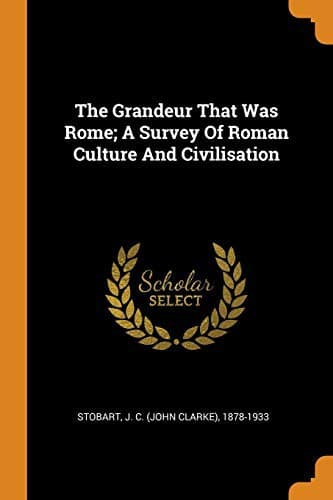
The Grandeur That Was Rome: a survey of Roman culture and civilisationStobart, J. C. (John Clarke)
History
The Grandeur That Was Rome: a survey of Roman culture and civilisation
Stobart, J. C. (John Clarke)
Rome -- Civilization; Rome -- History
While Pompeius was absent the so-called democracy, which mostly
consisted of hired ruffians in the pay of discontented nobles, ruled
the streets of the city. Among the young nobles who took this side
was one more dissolute and more foppish than the rest, a notorious
adulterer and spendthrift, Gaius Julius Cæsar. Though of the highest
birth--the goddess Venus by her marriage with the father of Æneas
was among his ancestors--he was also by lineage associated with the
democracy. His aunt was the wife of Marius, and his wife was a daughter
of Cinna. He began his public career quaintly enough as _pontifex
maximus_. When Julia the widow of Marius died, young Cæsar had the
audacity to display images and utter an oration in praise of Marius.
This, as was intended, set all the gossips talking, and his amazing
extravagance kept him well in the public eye. On one occasion he
exhibited three hundred gladiators in silver armour, although he was
known to be penniless. Probably Crassus was his financier all along.
At this time there was another of the frequently recurring financial
crises at Rome. Everybody was deeply in debt, and loud rose the cry
for the clean slate, as part of the democratic programme--the only
intelligible part. This was the cause of the famous conspiracy of
Catiline, who, if Cicero may be trusted, proposed to seize and burn
Rome by the aid of the discontented Sullan colonists in Etruria.
Both Cæsar and Crassus are said to have favoured the plot, but it is
exceedingly difficult to see what a large owner of Roman house property
had to gain by it. Cicero was the consul for the year 63, and though it
is the fashion just now to sneer at Cicero, he seems to have displayed
courage and promptitude in dealing with the conspirators. Unfortunately
his arrest and execution of Catiline was technically illegal. Cicero
himself, as a parvenu, was naturally an aristocrat, and his policy,
though futile, was intelligible. Briefly, it was to unite the senate
with the capitalist class in what he called the “union of the orders”
against the democratic elements of disorder. Pompeius came home from
the East to find the conspiracy crushed. He and his legions were not
wanted. With incredible folly and ingratitude the senate, led by
Cicero, refused even to grant the lands he had promised to his veterans.
Public-domain text, read in full here on John Shaqi.
Reviews
Reviews
No reviews yet
Be the first to share your thoughts on this work.
Elsewhere in the archive
Join the Discussion
Join the discussion
Sign in to leave a comment or review.
Sign InorCreate an account