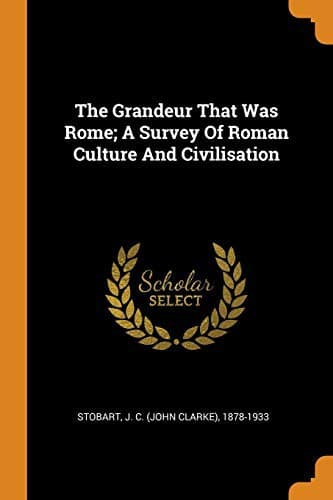
The Grandeur That Was Rome: a survey of Roman culture and civilisationStobart, J. C. (John Clarke)
History
The Grandeur That Was Rome: a survey of Roman culture and civilisation
Stobart, J. C. (John Clarke)
Rome -- Civilization; Rome -- History
The golden age of classical literature covers this last half-century
of the Republic and the first half-century of the Empire. There is, on
the whole, little trace of division between the general character of
Republican and Imperial letters except that with Augustus the principal
writers are definitely engaged under the Emperor’s banner of reform.
The main characteristic of both is rhetoric and convention. It is to
Alexandria and its state-fostered writing-club that the world owes
convention in literature. The Romans drew their inspiration from Greece
but mainly from Alexandria, and as literature at Rome was now chiefly
in the hands of a clique of nobles it was possible for a classical
style to grow strong there. Cicero and his friends evolved a style, not
only of literature but even of thought, which could pronounce itself
as “urbane,” and all else as barbarian or rustic. Roman literature
of the first centuries before and after Christ was as much under the
domination of epithets like “urbane” and “humane” as was the literature
of the eighteenth century under “elegant” and “ingenious.” Even Livy as
an outsider was suspected of mingling “Patavinity” with his Latinity.
It is the aristocracies of literature, such as the court of Louis XIV.
or of Charles II., or such as the coffee-house cliques of Addison’s
day or the Johnsonian clubs, which create and maintain our periods of
classical convention.
Literature, as we have already seen occasion to remark, since it
works in the most plastic medium, is generally the first of the arts
to develop; and literature is only yet beginning. But then Rome
borrowed her arts wholesale from Greece, and thus her culture has no
true infancy. The burning problem of Roman originality in Art must be
reserved until we reach the Augustan age. For the present we must still
deny the existence of any really spontaneous art growth at Rome during
the Republic. Where native art may be looked for with the highest
probability of finding it is in architecture, portrait-sculpture, and
painting; in architecture, partly because the Romans had a natural
passion for building and partly because their religious and social
habits called for quite distinct types of construction in palaces,
halls, amphitheatres, triumphal arches, _fora_, and other secular
buildings upon which the Greeks had wasted little of their attention;
in portraiture because it was a peculiar custom at Rome to make and
display images of their ancestors, whereas the Greeks in their love
of the ideal had until latterly shrunk from the presentation of
casual human lineaments and still idealised them as far as possible,
and also because the Etruscans, who were the first nurses of Roman
culture, had developed portraiture for themselves; and in painting,
partly owing to the same Etruscan influence and partly because the
Romans, using inferior building materials such as brick, limestone, and
terra-cotta covered with stucco, were naturally drawn to mural painting
Public-domain text, read in full here on John Shaqi.
Reviews
Reviews
No reviews yet
Be the first to share your thoughts on this work.
Elsewhere in the archive
Join the Discussion
Join the discussion
Sign in to leave a comment or review.
Sign InorCreate an account