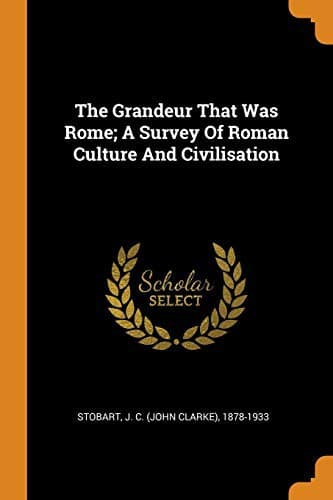
The Grandeur That Was Rome: a survey of Roman culture and civilisationStobart, J. C. (John Clarke)
History
The Grandeur That Was Rome: a survey of Roman culture and civilisation
Stobart, J. C. (John Clarke)
Rome -- Civilization; Rome -- History
Vergil’s Fourth Eclogue, from which my text is quoted,
is often called the “Messianic Eclogue.” It is a strange poem. In the
midst of a book of pastoral eclogues very closely modelled on the
Idylls of Theocritus, the young poet from Mantua inserts one in which
he invites the Sicilian Muses, that is, the Muses of Theocritus, to
assist him in a loftier strain than usual. His poem is a vision, a
prophecy of a return of the golden age to accompany the birth of a
child. It is not easy to determine what child. The poem was written
for the consulship of Pollio, who had helped Vergil to recover his
paternal farm. Thus it is very probable that the poem was really a
piece of very gross flattery directed to a patron. Nevertheless the
prophecies of peace on earth which it foreshadows chime so strangely
with the Messianic language of Isaiah that the scholars of the Middle
Ages alternatively placed Vergil among the prophets or condemned him
as a wizard. But apart from that approaching event to be witnessed in
an obscure village of the client-princedom of Judæa there was even
in secular history a general expectation of better days to come.
The Virgin Justice did in sober fact return to the Roman world when
Octavian, in 29 B.C., came home to celebrate his triumph over the three
continents.
I make high claims for Octavian[41]--or as he may now be called by
anticipation “Augustus”--in history. Julius Cæsar has usurped the
credit of inventing that wonderful system the Roman Empire. The credit
really belongs to Augustus. Monarchy, indeed, had for two generations
at the least become inevitable at Rome, as everybody, from Catiline to
Cicero, was bound to admit. In the scramble to realise it Julius Cæsar
had won the day and had thereupon proceeded to introduce his conception
of its proper form. He died before his plans were perfected and we
have no means of knowing his inner purpose. But we know that he had
spurned the dignity of the senate, had taken some of the paraphernalia
of royalty and set up his statue alongside of the old kings of Rome.
His plan of a naked despotism had failed, because he had not reckoned
with the tyrannicide sentiment of the Roman nobles. His assassination
was no mere episode or accident. It was impossible to live like an
oriental despot in the republican city without an oriental bodyguard.
Julius Cæsar had failed through pride. When he fell, the whole dreary
round of proscriptions, triumvirate, and civil wars had to begin again.
The inevitable monarchy had to be devised afresh on a different basis:
that was the task of Augustus. He devised it in such a manner that it
lasted in the West for just five centuries and in the East for nearly
fifteen. Indeed it can hardly be said to be totally extinct now in the
twentieth. Judged by results then, the work of Augustus was clearly
a consummate piece of statesmanship. When we consider the methods by
which that result was obtained we shall, I think, esteem Augustus as
Public-domain text, read in full here on John Shaqi.
Reviews
Reviews
No reviews yet
Be the first to share your thoughts on this work.
Elsewhere in the archive
Join the Discussion
Join the discussion
Sign in to leave a comment or review.
Sign InorCreate an account