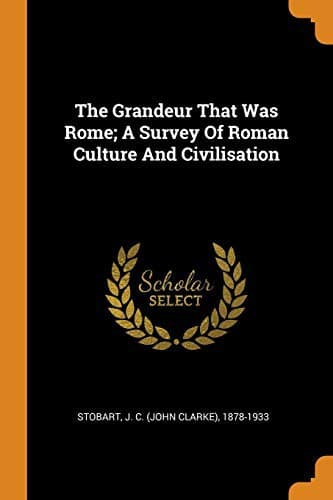
The Grandeur That Was Rome: a survey of Roman culture and civilisationStobart, J. C. (John Clarke)
History
The Grandeur That Was Rome: a survey of Roman culture and civilisation
Stobart, J. C. (John Clarke)
Rome -- Civilization; Rome -- History
By this time the principate had taken its permanent form. Its powers
vary considerably with the varying force of the individual emperors,
and it tends by mere prescription as well as by the development of an
administrative hierarchy of officials to grow more absolute as the
years advance. But constitutionally very little change was made in the
course of the next three centuries. It always remained a compromise,
and something of illegitimacy always clung to it. From time to time
the senate actually remembered that it was a governing council. It had
always to be reckoned with. As for the comitia of the Populus Romanus,
they continued to exist both for legislation and elections as long as
Augustus was alive. But in reality the princeps had taken the place
of the people in the government of Rome. Tiberius, the next successor
of Augustus, suppressed the comitia as unnecessary, and though once
or twice in later times an antiquarian emperor might get a plebiscite
passed for the sake of old times, the Populus Romanus was extinct. It
perished without a groan.
The personality of a monarch had been thrust almost surreptitiously
into the frame of a republican constitution. Skilfully as it had been
done, the illegitimacy of the proceedings entailed certain awkward
consequences. There could be no open talk of a succession. Thus when
Augustus recovered from his grave illness in 23 B.C. he offered to read
his will to the senate to prove that he had nominated no successor.
On the contrary, he had formally handed to Piso, the other consul, a
written statement of the disposition of the forces and the moneys in
the treasury. That was true enough, but he had handed his signet ring,
the ring by virtue of which Mæcenas had governed Rome for ten years,
to Agrippa, the man who would certainly have taken his place if he
had died at that time. In reality there is little doubt that in his
own mind Augustus had planned to make young Marcellus, the brilliant
child of his beloved sister Octavia, his heir and successor. That
this ultimate intention was plain to Agrippa when Cæsar recovered
is shown by Agrippa’s sulky retirement into private life. Although
Augustus could not directly or legally nominate a successor, he could
train a young prince for the succession, and in his own lifetime raise
him to such a point of honour that he would naturally step into the
vacant place. The newly born Empire had the great good fortune that
Augustus, in spite of his feeble health, lived to a ripe age and held
the principate for forty-one years. But it had the misfortune to be
governed by a sterile race. Not for a hundred years until Titus, did
a son succeed his father. Augustus had nephews, stepchildren, and
grandchildren, but he had only one child by his three wives, and she
was the immoral Julia. All his life long he was vexed with tiresome
dynastic problems, and each youth whom he selected for his successor
seemed to be destined to a premature death. At the last he was driven
Public-domain text, read in full here on John Shaqi.
Reviews
Reviews
No reviews yet
Be the first to share your thoughts on this work.
Elsewhere in the archive
Join the Discussion
Join the discussion
Sign in to leave a comment or review.
Sign InorCreate an account