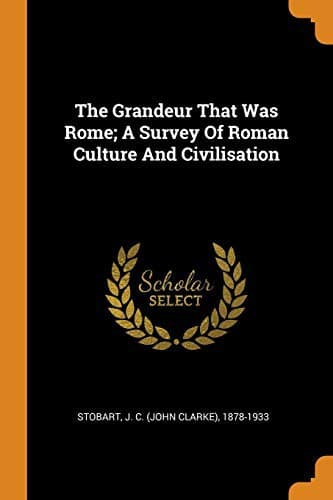
The Grandeur That Was Rome: a survey of Roman culture and civilisationStobart, J. C. (John Clarke)
History
The Grandeur That Was Rome: a survey of Roman culture and civilisation
Stobart, J. C. (John Clarke)
Rome -- Civilization; Rome -- History
Augustus was, as we have seen, a statesman and not a soldier. The
stories of his cowardice, repeated by Suetonius, are confessedly
drawn from the venomous letters of his enemy, Antony. Augustus had
emerged successfully through five civil wars, had crossed tempestuous
seas in small boats, had faced mutinous armies and every sort of
hardship. But all his instincts were for peace and statecraft. We have
seen that it was the need of a standing army at Rome which led to the
need of permanent generals, and this to the downfall of the old Roman
constitution. When Cæsar built his throne on the ruins of the Republic
the plain fact was that the general had become monarch. Thus, in spite
of the fact that Augustus was not of a military character, and in spite
of all his efforts to prevent it, the monarchy of the Roman Empire was
eventually revealed as a military despotism. It was the irony of fate
that such a man as Augustus should have founded such a monarchy.
But for the present the ugly fact that the army had bestowed the purple
was decently concealed. Augustus from the very beginning of his power
did his best to reduce the military element in the state. During the
civil wars, and indeed for fifty years before they began, the troops
had made and unmade consuls, there had been constant mutinies and
blackmail in the army. Cæsar’s own first consulship had been obtained
in this way. A centurion had marched into the senate-house and cried,
“If you will not make him consul, _this_”--and he tapped the hilt of
his sword--“this shall.” But now the older discipline was revived.
Agrippa in particular was a stern disciplinarian of the old school.
The soldiers were flattered no longer. No more legionary coins were
issued. For an honour a legion was allowed to call itself Augusta, for
a punishment the title was revoked. The highest military distinction,
the triumph, was gradually reserved for the princeps and the members
of his house alone. Even when the title of Imperator was earned by a
victorious general it was transferred to him. But it was his aim to
see that no private citizen should have the opportunity of securing
the high military honours. Agrippa might have been dangerous and
accordingly he was brought into the family by marriage with Cæsar’s
daughter. But for the rest the conduct of important operations was
almost always confided to one of the young princes--to Tiberius, or
Drusus, or Germanicus. And they were always victorious. When Quintilius
Varus, a general of humbler birth, was allowed to lead a great army
he conveniently pointed the moral by a signal failure. No senatorial
governor might now levy troops or declare war on his own account.
Public-domain text, read in full here on John Shaqi.
Reviews
Reviews
No reviews yet
Be the first to share your thoughts on this work.
Elsewhere in the archive
Join the Discussion
Join the discussion
Sign in to leave a comment or review.
Sign InorCreate an account