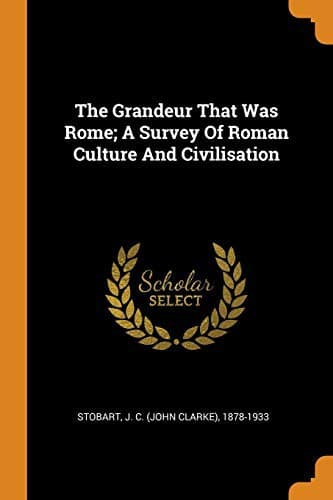
The Grandeur That Was Rome: a survey of Roman culture and civilisationStobart, J. C. (John Clarke)
History
The Grandeur That Was Rome: a survey of Roman culture and civilisation
Stobart, J. C. (John Clarke)
Rome -- Civilization; Rome -- History
Perhaps no country in the world has had such a chequered and miserable
history as the pleasant island of Sicily with its rich volcanic soil.
For four hundred years it had been mainly Greek. The eastern end, at
least, had been scattered with important city-states which, under
the leadership of Syracuse, had waged incessant conflict with the
Carthaginian invaders in their western strongholds. We have seen how
the Romans finally drove out the Semitic element and conquered the
Greeks. During the latter part of republican history the island had
been of vital importance to Rome as supplying through its tribute the
chief part of the corn-supply. At the same time it had been cruelly
exploited and oppressed by Roman governors like Verres. Then during
the civil wars Sextus Pompeius had made it his head-quarters, and it
had been laid under heavy contributions by both sides. Messina, its
richest town, had been the scene of a sack and massacre. No country had
more to hope from the Pax Augusta, and it now began to enjoy one of
its brief periods of rest. Augustus spent the winter of 22 in Sicily
at the beginning of his tour in Greece. He founded colonies at six
famous cities of old. While he was in the island the Sicilians offered
him a kind of round-robin of complaint against the extortion of his
procurator. Augustus instantly dismissed the offender and replaced him
by his own valued tutor, the philosopher Areus. It was thoroughly in
accordance with his policy to put a Greek philosopher in charge of a
Greek island.
So far we have been surveying the treatment of that part of the Roman
world which was already quite civilised and mainly Greek. We now turn
to the barbarian West and North, mainly consisting of newly conquered
Cæsarian provinces. In these quarters, the nearer parts of Spain and
the Narbonensian province of Gaul were the only regions which could be
called civilised. As soon as the provisional settlement of 27 b.c. was
effected Augustus hurried away to Gaul. It was generally thought that
he was on his way to conquer Britain, for that was the second of the
two tasks which Julius had left to his successor. Accordingly the loyal
Horace dutifully prays:
serues iturum Cæsarem in ultimos
orbis Britannos.[45]
Public-domain text, read in full here on John Shaqi.
Reviews
Reviews
No reviews yet
Be the first to share your thoughts on this work.
Elsewhere in the archive
Join the Discussion
Join the discussion
Sign in to leave a comment or review.
Sign InorCreate an account