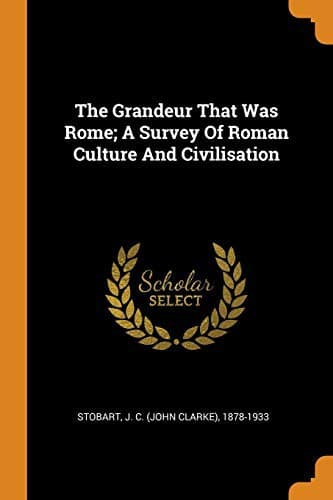
The Grandeur That Was Rome: a survey of Roman culture and civilisationStobart, J. C. (John Clarke)
History
The Grandeur That Was Rome: a survey of Roman culture and civilisation
Stobart, J. C. (John Clarke)
Rome -- Civilization; Rome -- History
Spain had never been entirely subjugated though it had been in the
possession of the Republic for nearly two centuries. Parts of it indeed
were almost as Roman as Rome. Gades and Corduba, for example, were
centres of learning and literature, soon to produce citizens of renown
in Lucan, Seneca, Martial, Quintilian, and an emperor in Trajan--a most
distinguished galaxy. But a great part of Spain was still in the hands
of wild and chivalrous barbarians. Particularly in the north-west the
Cantabrians and Asturians were a menace to the peaceful province. For
eight years and more the Romans continued to fight them with brief
intervals termed “victories.” Augustus himself came over in 26 B.C. and
directed operations comfortably from Tarraco. The leader of the rebels
was a hero-chief called Corocotta who so exasperated the Romans that
Augustus offered £10,000 for his capture. This sum the brigand earned
by walking into the Roman camp to surrender, and Augustus, charmed at
the idea, gave him his liberty as well as the reward. He married a
Roman wife and died a Roman citizen as Gaius Julius Caracuttus. Cæsar
himself fell seriously ill in the course of the long campaign. Both
sides increased in ferocity. The Romans crucified their prisoners and
the Spaniards mocked them from the cross. Finally Augustus had to send
for Agrippa to finish the business, which he did in 19 B.C. Now Spain
was really conquered for ever and even the northern highlanders laid
down their arms and accepted civilisation. Bætica, the southern part of
the peninsula, was given to the senate to govern, and the northern half
divided into the two imperial provinces, Tarraconensis and Lusitania,
the latter corresponding roughly to modern Portugal. In Spain also
altars were erected to Rome and Augustus. Roads radiated out from
Tarraco. Many towns were founded, such as Cæsar Augusta (Saragossa),
Augusta Emerita (Merida), Pax Julia (Beja), Legiones (Leon), Asturica
Augusta (Astorga). The Celtic religion and probably the very language
quickly became extinct. Even in the time of Augustus there were fifty
communities with full Roman citizenship. New mines were discovered
and vigorously worked, new industries, especially in metal, carefully
fostered.
* * * * *
Public-domain text, read in full here on John Shaqi.
Reviews
Reviews
No reviews yet
Be the first to share your thoughts on this work.
Elsewhere in the archive
Join the Discussion
Join the discussion
Sign in to leave a comment or review.
Sign InorCreate an account