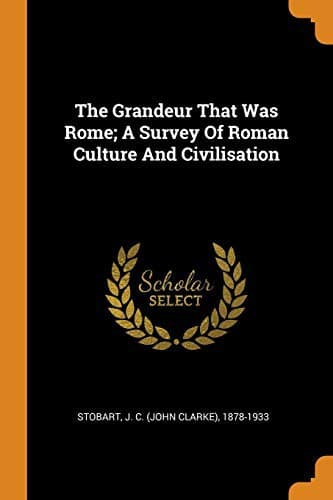
The Grandeur That Was Rome: a survey of Roman culture and civilisationStobart, J. C. (John Clarke)
History
The Grandeur That Was Rome: a survey of Roman culture and civilisation
Stobart, J. C. (John Clarke)
Rome -- Civilization; Rome -- History
fully developed.[77] Hadrian, the cultured, travelling Philhellene,
encouraged a reversion to the classical traditions of Greek art. The
art of his period was profoundly influenced by the type of Antinous,
a beautiful youth beloved by the emperor, whose romantic death by
drowning in the Nile made a powerful impression upon the whole Roman
world, because he was believed to have sacrificed his life for his
emperor’s in obedience to an oracle. This type is preserved for us in
many forms, but most notably in the colossal Mondragore bust in the
Louvre[78] and the bas-relief in the Villa Albani.[79] His features
were utilised to represent all the young male gods on Olympus. In their
tragic beauty we see a mirror of Greece tinged by the Orient, as if
Dionysus had wedded Isis and this were the offspring. The Antonine
period, as exhibited on the panels in the Palazzo dei Conservatori,
is gifted with immense technical fluency and, as Mrs. Strong remarks,
a new spiritual seriousness. As compositions they are superb, but the
weakness of expression in the face of Marcus Aurelius himself quite
spoils their effect for some spectators.[80]
Architecture was still mainly designed in the three Greek modes
variously combined, in spite of the fact that Rome had progressed far
beyond Greek limits in constructional ability. Roman builders could
manage a roof-span far in excess of the Greeks. The Roman arch gave
a strength in concrete vaulting which expensive marble was unable to
attain. Roman brickwork denuded of the marble incrustations which
generally covered it of old is probably more impressive in its ruins
than it was when it was draped with Hellenism, and, to me at least,
remains like the aqueduct at Pont du Gard[81] and the Bridge of
Alcantara[82] seem truer witnesses of the grandeur of Rome than all the
marbles in all the museums. The celebrated Castle of St. Angelo, which
still keeps watch and ward over the Tiber, is nothing but the core of
Hadrian’s tomb--the _Moles Hadriani_--once clad in a vestment of Greek
marbles and covered with Greek ornament.[83] The Pantheon, in spite of
the inscription which ascribes it to Agrippa, is proved by the marks on
its bricks to be a restoration of Hadrian’s time. It is indeed a superb
example of vaulting and a miracle of construction. The plan is that of
a dome so constructed that if the sphere were complete it would rest
upon the earth. The magnificent interior has lost little of its ancient
splendour.[84]
Public-domain text, read in full here on John Shaqi.
Reviews
Reviews
No reviews yet
Be the first to share your thoughts on this work.
Elsewhere in the archive
Join the Discussion
Join the discussion
Sign in to leave a comment or review.
Sign InorCreate an account