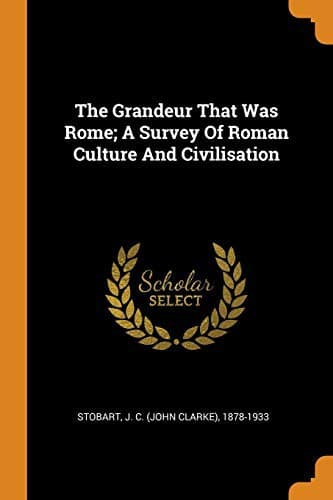
The Grandeur That Was Rome: a survey of Roman culture and civilisationStobart, J. C. (John Clarke)
History
The Grandeur That Was Rome: a survey of Roman culture and civilisation
Stobart, J. C. (John Clarke)
Rome -- Civilization; Rome -- History
Much attention has been paid in recent years to the religious
development of the Romans under the Empire, and to the momentous
conflict of religions which was going on from the age of Hadrian until
the final triumph of Christianity. Humanly speaking, it was “touch
and go” between several religions competing for the vacant place in
the faith of the Empire, and at the last the strife was practically
narrowed down to a duel between two oriental monotheistic systems,
Mithraism[91] and Christianity. The subject is too vast for anything
like adequate treatment here. But I would emphasise one point of view
which is often overlooked.
The Roman state is too often regarded merely as the enemy and
persecutor of the Christian religion. It is forgotten how large a share
Rome may claim in its establishment. Not only did the Romans discover
Christianity, but they organised it and sent it forth conquering and
to conquer in the wake of the legions. It is not a case of a wicked
and corrupt people suddenly converted in the midst of its sins. On the
contrary it is easy to show that the thinkers of the Roman Empire were
tending towards philosophic and religious ideas which made them ready
to accept with astonishing rapidity both the ethical teaching and the
theological revelations of the Son of God. It is unnecessary to remind
the modern reader how large a part the Greek philosophy of Stoicism
with its Roman modifications had played in shaping the thoughts of one
Roman citizen, Paul of Tarsus. Philo, the Alexandrian Platonist, had
developed a doctrine of the Divine _Logos_, which profoundly influenced
the philosophy of the fourth Evangelist, and through him the whole
course of Christian teaching.
The Romans may have added little to abstract philosophy or to
metaphysics, but they made the somewhat barren abstractions of Zeno the
Stoic into something more than a philosophy, into a faith which had a
power to influence conduct far beyond the power of the State system of
half-Greek Olympian Gods. If the power and the sincerity of a religion
may be tested rather by its martyrs than by its proselytes, Stoicism
had a worthy record. Men like Thrasea Pætus, Helvidius Priscus, and
Barea Soranus were facing the tyrant’s frown for the sake of their
Stoic sense of duty, just as truly as Peter and Polycarp.
Public-domain text, read in full here on John Shaqi.
Reviews
Reviews
No reviews yet
Be the first to share your thoughts on this work.
Elsewhere in the archive
Join the Discussion
Join the discussion
Sign in to leave a comment or review.
Sign InorCreate an account