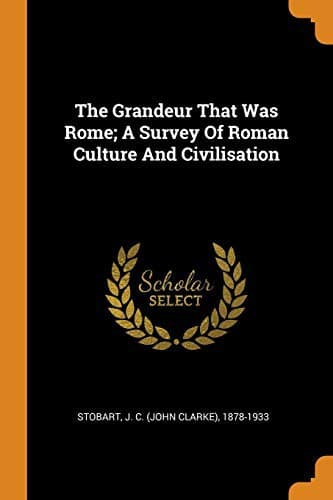
The Grandeur That Was Rome: a survey of Roman culture and civilisationStobart, J. C. (John Clarke)
History
The Grandeur That Was Rome: a survey of Roman culture and civilisation
Stobart, J. C. (John Clarke)
Rome -- Civilization; Rome -- History
Simultaneously with the Jugurthan war the Romans were called upon to
face a far more serious affair, one of those great folk-wanderings
from the north which occur periodically in the course of Mediterranean
history. The Cimbri and Teutons, who may have numbered ancestors of our
own among them, came down from the shores of the Baltic, travelling
with their households in a train of waggons which took six days in
defiling past the onlooker. These barbarians were terrible to the
Romans, with their strange aspect, their long iron swords and savage
war-cries, their fair hair and giant stature. But of course they were
savages compared to the Romans, and they should never have inflicted
more than one defeat on intelligent generals of disciplined armies.
As it was, they had to face mutinous legions and incompetent consuls.
First they defeated Carbo and overran Gaul; then coming south into
the province they beat Silanus and Scaurus; and then, united with the
Helvetians, they inflicted a frightful disaster on Longinus, when a
Roman legate had to surrender, and another Roman army was sent under
the yoke. In 105 a worse thing happened: the great defeat of Arausio
(Orange) seemed more fatal even than Cannæ in the extent of its losses.
There was a panic in Italy, which seemed helplessly exposed to the fury
of the northmen, but fortunately the aimless barbarians wandered off
into the west and spent their strength on the warlike Spanish tribes.
As before, popular indignation at Rome, diverted from the real cause
of the mischief, the rotten system of cliques which governed them,
wasted its fury on individuals. Senators were mobbed and stoned.
A proconsul was actually deposed from office. There was only one
man deemed capable of dealing with the peril--Marius, the man of
the people, the triumphant conqueror of Jugurtha. So, despite laws
forbidding re-election, Marius became consul for a second time and a
third--five times consul. This was symptomatic of a changed Rome. It
was, however, necessary. Amateur generals had had a long trial. From
104 to 100 Marius was continuously chief magistrate of the state, as
well as generalissimo of its armies. He did his work. First he had to
get his army in hand, and accustom them to the sight of the terrible
barbarians. Then he dealt two smashing blows at the Teutons and Cimbri
near Aquæ Sextiæ and on the Raudine Plain. It was the misfortune of
the Roman system of imperium that no general could attain to eminence
in war without at the same time acquiring political importance.
Hence Marius in 100 B.C. found himself absolutely first in the Roman
state without education or even common sense in politics. He presents
a pathetic figure in the turbulent world of Roman statecraft, a
war-scarred veteran, the indubitable saviour of Rome, called upon to
play the part of a statesman, and yet a mere puppet in the hands of
unscrupulous intriguers. First he fell into the hands of two shameless
Public-domain text, read in full here on John Shaqi.
Reviews
Reviews
No reviews yet
Be the first to share your thoughts on this work.
Elsewhere in the archive
Join the Discussion
Join the discussion
Sign in to leave a comment or review.
Sign InorCreate an account