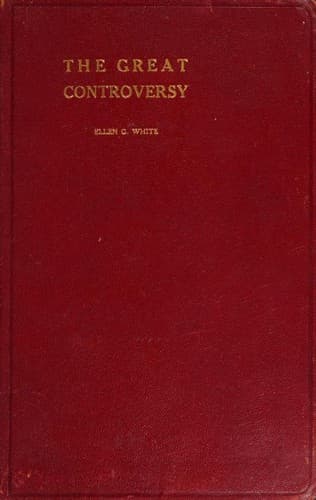
The Great Controversy Between Christ and SatanWhite, Ellen Gould Harmon
ReligionComparative
The Great Controversy Between Christ and Satan
White, Ellen Gould Harmon
Good and evil; Seventh-Day Adventists -- Doctrines; Spiritual direction
While Luther was opening a closed Bible to the people of Germany, Tyndale
was impelled by the Spirit of God to do the same for England. Wycliffe’s
Bible had been translated from the Latin text, which contained many
errors. It had never been printed, and the cost of manuscript copies was
so great that few but wealthy men or nobles could procure it; and
furthermore, being strictly proscribed by the church, it had had a
comparatively narrow circulation. In 1516, a year before the appearance of
Luther’s theses, Erasmus had published his Greek and Latin version of the
New Testament. Now for the first time the word of God was printed in the
original tongue. In this work many errors of former versions were
corrected, and the sense was more clearly rendered. It led many among the
educated classes to a better knowledge of the truth, and gave a new
impetus to the work of reform. But the common people were still, to a
great extent, debarred from God’s word. Tyndale was to complete the work
of Wycliffe in giving the Bible to his countrymen.
A diligent student and an earnest seeker for truth, he had received the
gospel from the Greek Testament of Erasmus. He fearlessly preached his
convictions, urging that all doctrines be tested by the Scriptures. To the
papist claim that the church had given the Bible, and the church alone
could explain it, Tyndale responded: “Do you know who taught the eagles to
find their prey? Well, that same God teaches His hungry children to find
their Father in His word. Far from having given us the Scriptures, it is
you who have hidden them from us; it is you who burn those who teach them,
and if you could, you would burn the Scriptures themselves.”(361)
Tyndale’s preaching excited great interest; many accepted the truth. But
the priests were on the alert, and no sooner had he left the field than
they by their threats and misrepresentations endeavored to destroy his
work. Too often they succeeded. “What is to be done?” he exclaimed. “While
I am sowing in one place, the enemy ravages the field I have just left. I
cannot be everywhere. Oh! if Christians possessed the Holy Scriptures in
their own tongue, they could of themselves withstand these sophists.
Without the Bible it is impossible to establish the laity in the
truth.”(362)
A new purpose now took possession of his mind. “It was in the language of
Israel,” said he, “that the psalms were sung in the temple of Jehovah; and
shall not the gospel speak the language of England among us?... Ought the
church to have less light at noonday than at the dawn?... Christians must
read the New Testament in their mother-tongue.” The doctors and teachers
of the church disagreed among themselves. Only by the Bible could men
arrive at the truth. “One holdeth this doctor, another that.... Now each
of these authors contradicts the other. How then can we distinguish him
who says right from him who says wrong?... How?... Verily by God’s
word.”(363)
Public-domain text, read in full here on John Shaqi.
Reviews
Reviews
No reviews yet
Be the first to share your thoughts on this work.
Elsewhere in the archive
Join the Discussion
Join the discussion
Sign in to leave a comment or review.
Sign InorCreate an account